The short film Guided Tour (25 minutes) is available at the top of the page.
* To watch this film, please approve YouTube/Vimeo cookies via the blue cookie icon at the bottom left of the screen.
Guided Tour (2009) is Benjamin Freidenberg’s graduation short at the Sam Spiegel Film and Television School. It was named Best Short Film at the 2009 Jerusalem Film Festival, and claimed the same distinction at a student film festival the following year. In a 2019 poll it placed third among the thirty most cherished Sam Spiegel films. Nearly two decades later, the esteem and affection it inspires remain as strong as ever. What is it about the film that stirs such intense feeling?
The film’s power lies in its capacity to tell an intimate story, trace the portrait of a city, and open onto philosophical reflection. From these qualities it shapes a cinematic experience that is singular and deeply moving.
The film follows Eitan, a resident of Jerusalem who paints road lines by night and talks to strangers on the phone by day. Its dramatic momentum is secondary. The film mobilizes visual language and the resources of cinematic expression to invite interpretation, in dialogue with the modernist films of the 1960s and 1970s. Those films cultivated contemplation and lingering, an emphasis on cinematic form, and reflexivity.
Guided Tour sets out to bind the European to the local, the narrative to the documentary. It bears the imprint of French cinema (Alain Resnais, Chris Marker, Marguerite Duras) and of Israeli cinema (David Perlov). Like Perlov’s poetic documentary In Jerusalem, it renders a cinematic portrait of the capital; and like Last Year at Marienbad, La Jetée, and India Song, it assembles an enigmatic mosaic that takes the language of cinema apart and reconstitutes it.
The fusion declares itself in the opening sequence, a wide shot of Jerusalem. Over images of the city, Eitan’s voiceover sets out what the ordinary tourist expects to see, and what a closer look might disclose. The camera picks out passersby in the urban environment, merging its own gaze with Eitan’s, still unseen on screen, and with the viewer’s. We are drawn into a cinematic space that unsettles the diegetic one, a vantage that is objective and subjective, omniscient and personal. As Eitan will later describe the experience of watching and being watched, someone is always unaware of being seen. The viewer, by contrast, enjoys the safety of those who see without being seen.
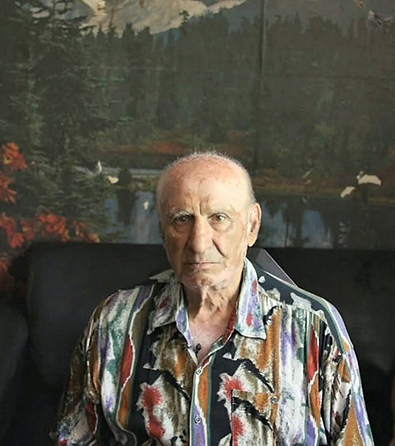
The film highlights the act of observing. Its camera’s point of view roves free of Eitan’s line of sight, watching and showing what he could never witness within the reality of the film. In voiceover, he introduces the characters around him: his father, the two painters who share his night shifts, and his neighbors in the building.
Eitan’s voiceover sharpens the film’s epistemological gap. The camera moves through the neighbors’ apartments and studies them, yet Eitan says he sees these neighbors only in the stairwell, never in the private scenes the camera enters. Is he the one who sees without being seen, or are these his projections, turned into the images we watch? The opening sequence ends with the neighbors filming themselves.
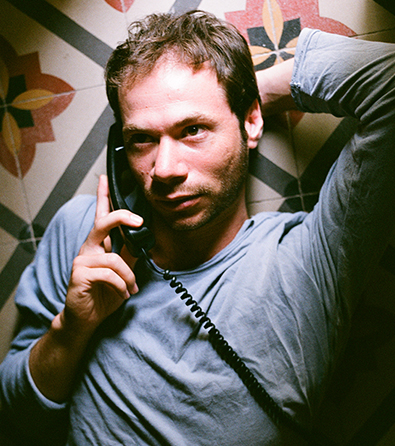
His account of them, laid out like a dating profile, leads into the next sequence, where he calls strangers on a dating hotline. The split between image and sound persists, underscoring the loneliness of Eitan and of those he talks to. The central exchange, with a woman called Shira, lets the film weave his interior world and deepen the alienation and solitude of the urban and cinematic space alike.
The suspension of narrative and the absence of drama yield a viewing experience that echoes the philosopher Gilles Deleuze’s distinction between the movement-image and the time-image. Deleuze argued that postwar cinema, modernist cinema included, no longer addressed its stories to the viewer’s conscious mind alone; it turned as well toward the unconscious, and how it processes memories, fantasies, and dreams.
Deleuze also stresses that camera movement is not bound to the movement of the characters in the frame; it can articulate an act of thought in its own right. The blurring of subjective and objective, real and imagined, grants the film what he calls a “camera consciousness.” The camera is no longer defined by the movements it can follow or perform, but by the mental relations it is able to enter.
One can see this clearly in the slow dolly movements of Guided Tour, which draw close to its characters, explore the spaces both urban and private, and blur what passes in Eitan’s mind with what exists in reality.
The film was released in 2009, yet it unmistakably echoes the difficult years Jerusalem endured during the Second Intifada. The fear of leaving home amid relentless terror bombings in the city’s public spaces intensifies the characters’ solitude and the contradictory, imagined reality that unfolds through Eitan’s eyes.
If Deleuze focuses on the camera’s status as an instrument of thought, Vivian Sobchack shifts the discussion toward the embodied experience of viewing. In her essay The Expanded Gaze in Contracted Space, she examines the existential possibilities that shape how a person looks at the world through cinema. She considers how the viewer and their gaze are “materially embodied in the space-time of the world with other objective beings and things,” and engaged in encounters that exceed the reach of human sight and action. The human gaze comes to discover how it diminishes before the vast, non-anthropocentric gaze of the universe: the human is not the one who imposes order and meaning on the world. For Sobchack, this surfaces in the very inanimate objects that surround us, whose sheer physical presence can express the secret metaphysics of existence. A close-up, for instance, can turn something familiar into an opening onto a wider world.
This brings us back to the film’s layered act of observing, another point of view, that of an outsider’s eye, through which Eitan frames what we watch. The film presses this tangible mode of seeing further still through a run of close-ups: a lollipop, clouds in the sky, white paint on the road, peas simmering in a pot, water from the laundry trickling down on a hot radiator. Their tight framing, shot on film by Ehud Harmoni, insists on their materiality and on their capacity to express something beyond what they plainly are. Through this accumulation of images, the film sets out to reveal “the flesh of the world,” the mystery that rises from the wide world that surrounds us.
The film stages a dialectic between an alienated reality and its power to disclose what lies hidden within itself. The human encounter never quite comes to pass, yet the possibilities it might have offered come fully into view. This complexity crystallizes in the film’s closing movement, at the revelation that is also its beating heart: Eitan’s father, whom we have seen several times, died years before the film was shot. Here Deleuze’s terms, camera movement as an expression of fantasy or memory, converge with Sobchack’s. The domestic spaces where we saw Eitan with his father now stand empty. The slow dollies voice the void his father’s absence leaves, and the images we watched become Eitan’s wish to picture the life he might have had were his father still alive.
This image reads as an expression of private and political anguish alike. As Yael Munk observes, many Israeli films sound an elegy for the death of the father figure. Munk describes the anxiety that rises in these films’ protagonists, confronted by the reality of the world as it reveals itself before them, an anxiety that drives them to retreat into subjective spaces, longing for a symbolic home they cannot build for themselves. The absence of the father, moreover, echoes the 1995 assassination of Yitzhak Rabin across the Israeli cinema that followed. Guided Tour, though, sets out to examine Israeli society in the aftermath of that trauma. (The symbolic subtext of Guided Tour becomes text in How I Killed Rabin [Michael Alalu, 2012], which draws deeply on the style of its predecessor.)
As Munk writes, the father figure dies, in reality or in metaphor, so that his children may forge a new moral consciousness. And so space, in its very concreteness, gives rise to lament, but also to hope for a better future: one in which Jewish and Palestinian workers labor side by side, in which the roads go on being painted at night, in which the city endures and holds within it, forever, the mystery of the world.
Almost twenty years on, the hope the film gives voice to feels as relevant as ever.