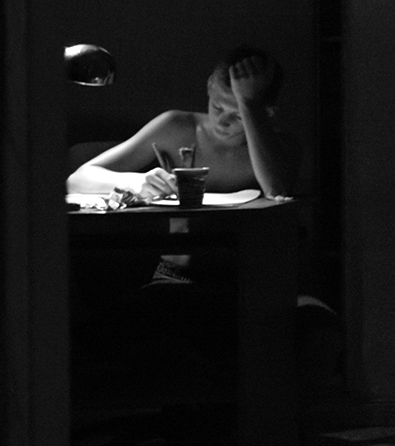
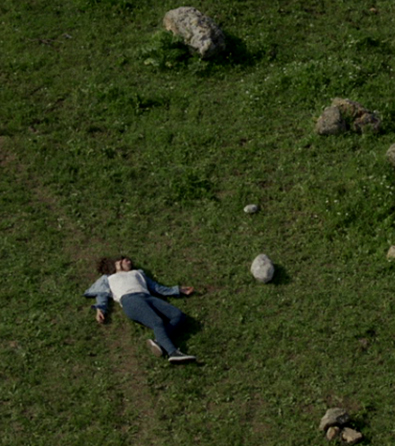
The short film Retouch (19 minutes) is available at the top of the page.
* To watch this film, please approve YouTube/Vimeo cookies via the blue cookie icon at the bottom left of the screen.
The short film Retouch (2017), written and directed by Kaveh Mazaheri, confronts the viewer with an unsettling experience centered on inaction, a moral decision to refrain that destabilizes the limits of empathy and understanding. While it is a short film, it operates on a far broader philosophical, ethical, and aesthetic scale. The film builds on central approaches in contemporary Iranian cinema, particularly reflexivity and abstraction, intensifying them through its precise visual and formal language.
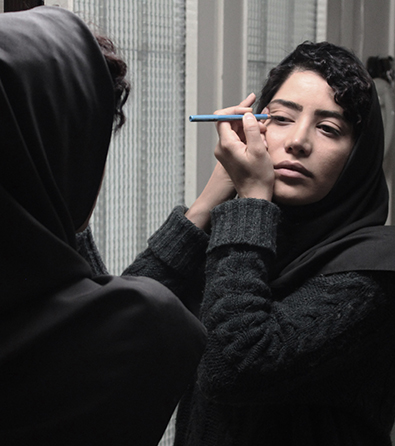
The film begins at an apartment, a seemingly familiar domestic space. Maryam, a young woman and mother to a little girl, moves through her morning routine: caring for her daughter, preparing for work, and inhabiting the ordinary rhythms of middle-class life. Her husband, who is exercising at home with weights, becomes trapped in a sudden and severe accident. A heavy bar presses against his neck, leaving him immobilized and helpless. At first, Maryam attempts to help him, but within moments, the film fractures. She stops. Rather than saving him, she steps back and watches as he suffocates. This decision to refrain from action becomes the defining moment of the film.
From this point onward, the drama no longer relies on external events but unfolds through a sustained deferral of the revelation of death. The husband dies, yet the film does not dwell on his death. Instead, it follows the life that continues afterward. Maryam moves through her day, going to work, speaking with colleagues, and carrying on as though nothing has occurred. His death becomes invisible, almost nonexistent. In this sense, the film traces a process of erasure, of a person, an event, guilt, and memory.
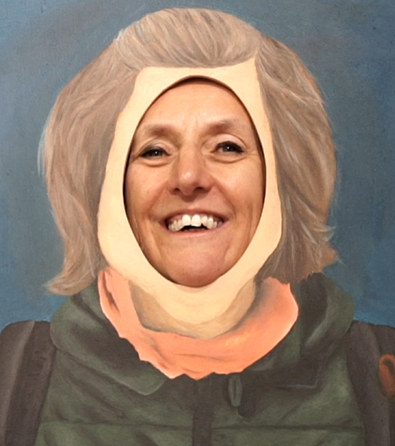
It is here that the film’s central metaphor emerges. Maryam works in photo retouching, correcting imperfections, removing unwanted details, and constructing an “improved” visual reality aligned with the patriarchal religious world in which she lives. Mazaheri does not treat this profession as incidental background, but as a thematic key to the film’s conceptual structure. The act of retouching becomes an analogue to her moral action. Just as she erases elements from an image, she erases the act itself from reality. Through editing, selection, and concealment, cinema becomes reflexive, a medium that reminds the viewer of its power to shape truth.
This reflexive dimension sharpens the film’s position within the tradition of Iranian cinema. Filmmakers such as Mohsen Makhmalbaf, Majid Majidi, and Abbas Kiarostami have developed a cinematic language that examines the relationship between reality and representation, and between truth and mediation. Kiarostami, in particular, explored the limits of documentary and the capacity of cinema to construct alternative realities. He often did so through a camera that observes characters reshaping their own narratives in the space between fiction and truth.
In later years, filmmakers such as Asghar Farhadi shifted this inquiry into the moral realm. His films place characters in situations of ethical conflict where truth is not singular, compelling the viewer to take a position. Farhadi constructs intricate dramas built on competing perspectives. Retouch continues this trajectory while pushing it further. It strips away multiplicity and leaves the viewer facing a single, almost inexplicable decision. There are no parallel narratives, no witnesses, and no legal or social framework to mediate the event. There is only one perspective, Maryam’s, and her refusal to act. In doing so, the film relinquishes conventional mechanisms of justification and confronts the viewer with a moral void.
This choice is also tied to Kaveh Mazaheri’s biography. Born in Tehran in 1981, he began his career as a film critic before turning to documentary filmmaking. Over the years, he developed a sensitivity to detail and everyday life. His transition to fiction does not abandon this background but deepens it. In Retouch, there is a strong sense of realism, a reliance on minimalist performances, and a deliberate avoidance of excessive dramatization. The camera observes, allowing the event to unfold at a natural pace. Mazaheri left Iran after completing the film during the Iranian women’s hijab protests in 2018.
The domestic space in which the film unfolds is particularly charged within the Iranian context. This is not overt brutality, but a latent force shaped by social pressure, patriarchal structures, and a suffocating routine. The husband is not portrayed as monstrous, yet the film does not invite empathy toward him either. The absence of information about their relationship leaves interpretation open: is this an act of revenge, survival, indifference, or a complete moral collapse? What preceded this moment?
This ambiguity is one of the film’s most significant achievements. Kaveh Mazaheri offers no answers, instead constructing a space of uncertainty. The viewer is compelled to fill in the gaps, projecting personal values and anxieties onto the situation. In this sense, the film functions as a mirror, asking not only what happened, but what it means for the one who watches.
Another element that reinforces the film’s reflexive dimension is its use of time. The film does not rush. It allows moments to stretch and glances to linger. This delay generates tension that does not depend on action, but on the anticipation of action that never arrives. It is a different kind of tension, not dramatic in the classical sense, but existential. The viewer waits for Maryam to act, to intervene, to alter the course of events, yet this expectation is repeatedly shattered.
Iranian cinema is renowned for its ability to transform budgetary, political, and censorial limitations into aesthetic strengths. Retouch stands as a clear example of this approach. Its minimalism is not only an artistic choice, but also a strategy: a reduction of means that allows for a concentrated expression of meaning. Every movement, every glance, and every cut carries weight. There is no excess, no distraction.
The film was widely acclaimed, receiving significant recognition and becoming one of the most discussed short films of the past decade. Among its major honors is the award for Best Narrative Short Film at the Tribeca Film Festival, alongside numerous international prizes.
Beyond its success, the importance of Retouch lies in its ability to rearticulate the role of cinema itself. It reminds us that cinema is not merely a tool for storytelling, but a mechanism of selection, editing, and erasure. Like Maryam, the filmmaker chooses what to reveal and what to conceal. The recognition of this power, and the responsibility it entails, is one of the film’s central themes.
Ultimately, Retouch offers no catharsis. It neither resolves its tension nor provides consolation. Instead, it leaves the viewer with an open, almost unbearable question: to what extent is our reality shaped by repetition and editing, and how far are we willing, or able, to erase from it what we cannot bear, testing the limits of our own spectatorship.
In one of his interviews, Kaveh Mazaheri explained that the film originated in his experience of watching a viral video in which a man becomes trapped beneath a heavy weight while the camera continues to record him. This suggests that the film’s primary impulse is not dramatic but cinematic: a prolonged, almost compulsive act of looking, in which the viewer does not intervene but observes. In this sense, Maryam mirrors the viewer, contemplating her deed. The film is therefore not only about a woman who does not save her husband, but about the very possibility of witnessing suffering without acting and doing something about it.
Mazaheri has noted that the film’s tension oscillates between horror and absurdity, between tragedy and moments that verge on the ridiculous. This observation clarifies the film’s emotional structure: the viewer cannot settle into a single, stable position. The moment when the situation shifts from “horrifying” to “almost laughable” produces deep discomfort, exposing the irrational mechanisms by which we respond to suffering. In this way, the film unsettles any expectation of moral or emotional stability, reflecting both human and cinematic complexity.
With regard to Maryam’s character, the film avoids presenting a broad sociological portrait of Iranian society, instead offering a more expansive, almost universal experience. It does so through a tight focus on the protagonist, her work, and her actions, while maintaining an open dramatic structure.
The film touches on a repressed fantasy, not necessarily of murder, but of the disappearance of the other, of release from a constraining relationship. Here, its psychoanalytic dimension comes into view: it does not merely depict an extreme act, but reveals a suppressed desire operating at an unconscious level. At the same time, Kaveh Mazaheri describes Maryam as someone who had already considered this possibility in the past, as part of a psychological mechanism through which individuals imagine extreme scenarios without acting on them. The moment that crystallizes this in the film is when fantasy turns into action. In this sense, the film functions as a thought experiment: what happens when a fleeting thought becomes reality? How does the subject change when the boundary between fantasy and action is crossed?
The wars of recent years in the Middle East, particularly in the Iranian context, have led to an overuse of terms such as “freedom” and “liberation,” to the point where their meanings seem increasingly hollow. Yet the film offers a more complex perspective: Maryam’s act does not necessarily lead to freedom. While she frees herself from the marital bond, she enters a state of perpetual concealment, compelled to “retouch” reality for the rest of her life. This reinforces the film’s reflexive dimension: retouching is not a one-time act, but an ongoing process of survival within a world that demands erasure and concealment, until these practices become internalized in everyday life. Freedom is revealed as an illusion, and life after the act becomes a form of continuous performance.
Another dimension of the film concerns the influence of censorship in Iran. Even if they did not directly shape the screenplay, they necessitate a cinematic language of suggestion, in which violence is not shown explicitly but emerges through absence. This is a distinctly Hitchcockian strategy, concerned with appearances and with anxieties that materialize into action. In this sense, Retouch operates not only as a story about a character, but as a reflection on the act of viewing itself, on the gap between thought and action, and on the unsettling possibility of shaping reality in the same way one shapes an image. A retouched reality emerges through the viewer’s gaze and the filmmaker’s vision.