The short film A Kind of Testament (16 minutes) is available at the top of the page.
* To watch this film, please approve YouTube/Vimeo cookies via the blue cookie icon at the bottom left of the screen.
Stephen Vuillemin’s animated short A Kind of Testament (2023) opens on a shot of resplendent flowers. Their color is intense, almost artificial in its saturation. For a moment, the flowers pulsate in full bloom and then crumble as flies circle around them. It is hard to imagine a more apt opening for a film about images that seek to preserve the body precisely because the body is bound to disappear. In sixteen minutes, Vuillemin builds a dense cinematic essay on fashion, death, ownership, replication, and identity, in an age when our personal archives build themselves almost without our noticing.
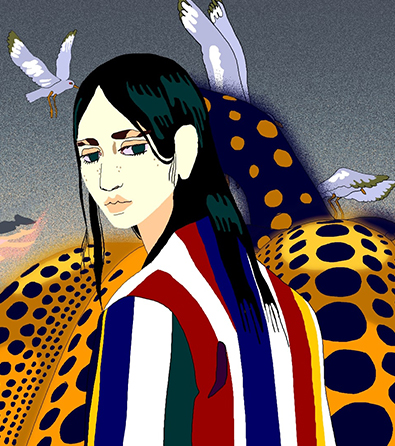
The story begins with an entirely mundane act. A young woman tries to buy a web address in her own name and discovers that the domain is already taken. On the site, she finds animated films based on photographs from her social media accounts. She recognizes herself in the details: clothes she wore, earrings, sunglasses, her dog, places where she was photographed. But the animations don’t merely copy the photographs; they extend them beyond the original frame and carry the lifestyle imagery into the grotesque territory of corpses, skeletons, animals, and death. As the film progresses, it becomes clear that an older woman who bears the protagonist’s name created the animations. The initial suspicion of identity theft gives way to something harder to define: an act of bequeathing to the next generation that is both an appropriation and a transmission. The shared name turns two women, strangers to each other, into doppelgängers. The images make one woman’s body raw material for the other, and animation allows the dead, or the dying, to live on through another person’s online persona.
From Garment to Sign
Fashion is one of Vuillemin’s principal narrative devices. Fashion designer Kerhao Yin selected the looks, and Vuillemin drew them from runway images. He sought out especially intricate pieces, detailed to the point of being exceptionally difficult to animate. Here, he all but defies the economic and structural logic of the medium: rather than sacrificing detail for the sake of movement, he piles layers, fur, textures, and accessories onto the body.
In Undressing Cinema (Routledge, 1997), film scholar Stella Bruzzi argues that costume in film is not merely an accessory in the service of characterization. Clothes, she contends, actively participate in producing cinematic identity and can even gain autonomy from the narrative. Seen this way, Vuillemin’s garments form a system of signs through which the character can be identified. The film can also be read alongside Roland Barthes’s Système de la mode (Éditions du Seuil, 1967; published in English as The Fashion System). For Barthes, fashion is first and foremost a system of meaning: more than a functional object, a garment is a sign that operates within a social code. Extended to the screen, that code plays a significant role in creating the cinematic icon.
In Vuillemin’s film, however, the garment goes a step further: beyond signaling class, taste, gender, and belonging, it functions like a digital signature. The protagonist knows the animated figure was modeled on her because she recognizes the earring, the coat, the glasses. For her, clothing is evidence. Call it a contemporary cogito: I wore it, therefore it is me. But the film quickly undercuts that assumption, too. Once a garment has been photographed, posted, and turned into an image, someone else can use it. The very sign meant to guarantee the subject’s uniqueness is what allows that subject to be replicated.
From Last Year at Marienbad to Instagram
A Kind of Testament invites comparison with Alain Resnais’s Last Year at Marienbad (L’Année dernière à Marienbad, 1961). In the film Resnais made with screenwriter Alain Robbe-Grillet, the past is a proposition. X tries to convince A that they met the year before, that they may have fallen in love and promised to run away together. Yet the film refuses to offer conclusive evidence for any of these possibilities. Spaces recur and shift, gestures are replicated, and different versions of the same event appear side by side. Robbe-Grillet himself stressed that the characters barely exist beyond what we see on screen, and that the past may be something the man invents in the very moment he tells it.
Within this unstable system, Delphine Seyrig emerges as one of the most stable images in the history of modernist cinema. Coco Chanel designed Seyrig’s wardrobe for the film: black gowns, chiffon, lace, pearls, and feathers that made her a figure both within her time and beyond it. Therein lies the key to comparing the two films. In Marienbad, the woman’s biography cannot be pinned down, but her silhouette can. Narrative memory fails where the memory of fashion succeeds. We do not know whether A was at Marienbad the year before, but we remember how she looked. The garment becomes, in effect, a substitute memory. It does not prove what happened, yet it grants the character the visual continuity the narrative refuses to provide.
Vuillemin’s film does almost the opposite. The garment is evidence here as well, but precisely because it can be recognized, it can also be copied. Where Resnais uses costume to steady a character the narrative dismantles, Vuillemin turns it into one of the mechanisms that dismantle a character’s ownership of herself. In other words, Last Year at Marienbad asks whether appearance can survive when memory fails, while A Kind of Testament asks what happens when a personal style survives too well.
The photograph the protagonist posted online was once tied to a specific moment: she was in a particular place, wore a particular garment, and had her picture taken. Once uploaded, however, the image gradually drifted away from the event that produced it. It can be downloaded, cropped, animated, and given an invented continuation. The body’s original presence becomes almost irrelevant. The everyday snapshot, seemingly insignificant, becomes charged the moment someone else adopts it and spends months or years turning it into animation. The replicated image becomes the ghost of its original.
The Fashion Film After the Fashion Film
In Vuillemin’s film, fashion points not to the present moment or the future, as it usually does, but to death. It is a postmortem fashion film, in which the wardrobe becomes the collection of belongings that may remain after a person is gone. Clothes have outlived bodies many times over in cultural history, and the digital age adds a new possibility: there is no need even to keep the garment itself. A photograph is enough. Hence the intriguing historical distance between Delphine Seyrig and Vuillemin’s protagonist. Seyrig’s iconic status grew out of a rare apparatus of stardom: an actress, a director, a cinematographer, and Coco Chanel creating an image that cinema then carried around the world. Vuillemin’s woman lives in a world where that apparatus has been privatized. Everyone is their own model, stylist, publisher, and archive, rolled into one. Social media has democratized iconicity and, in the same move, made it banal and open to appropriation.
The film can also be placed within a broader history of moments when the garment nearly breaks free of the character and begins to create meaning and memory of its own: Audrey Hepburn’s black Givenchy dress in Breakfast at Tiffany’s, Yves Saint Laurent’s clothes for Catherine Deneuve in Belle de jour, Maggie Cheung’s qipaos in In the Mood for Love, and Reynolds Woodcock’s gowns in Phantom Thread.
But Vuillemin adds a new condition to this tradition: a person can be replicated through their own wardrobe. The clothes express the character and, at the same time, allow her to be reconstructed. The decision to lavish enormous amounts of animation time on the details of the clothing is not, then, merely aesthetic excess. It goes to the heart of the film. The more detailed the garment, the more specific it is; the more specific it is, the more it seems to prove a link to a particular person; and the more recognizable it is, the more it can be used to rebuild that same person elsewhere.
Vuillemin’s Style: Animation as Archive
A Kind of Testament does not stray from Vuillemin’s earlier work. For years he has worked in the space between illustration, comics, animation, fashion, advertising, and design. His webcomic Lycéennes already explored how an animated GIF could serve both as ornament for a still image and as a narrative unit. His commercial career, which includes work for brands and for cultural and fashion institutions, ties together illustration, product, and an endless circulation of images.
That is why his animation, too, is not built primarily on fluid motion. Vuillemin thinks like an illustrator. Each frame seeks to retain something of the single image’s autonomy. One might say that the movement in the film does not erase the drawing but builds up over it. For the same reason, the film at times feels less like a caricature than like an archive brought back to life. Vuillemin turns stills into motion just as the older woman in the film turns the protagonist’s photographs into stories. The line between filmmaker and character blurs: the film itself performs the act it narrates.
A Testament Without an Inheritance
The word Testament in the title carries a precise double meaning: a covenant between two women, and a will that passes from one to the other. A will usually assumes a relatively clear system of ownership and inheritance: a person owns something and, upon death, passes it on to someone else. But what do we bequeath in an age of images? A face, a name, an Instagram account, a garment, a photograph of a garment, the memory of a photograph? The film raises the unsettling possibility that what we leave behind is not the self but a repository of material from which others will produce new selves.
The same mechanism offers another echo of Last Year at Marienbad. In Resnais’s film, the hotel where European society gathers is a memory machine: corridors, mirrors, sculptures, and gardens try to give shape to a past that cannot be verified. In Vuillemin’s film, that architecture has given way to digital infrastructure. The corridors are links, the rooms are folders, the mirrors are profile pictures, and the past is stored as JPEG and MOV files. In both films, the character is less stable than her image. Something about this feels melancholy, but it also rings true of contemporary visual culture. In Resnais, Chanel dresses a ghost whose past cannot be proven. In Vuillemin, Prada dresses a woman who is still alive, but whose image has already slipped away from her. The space is online, memory has become a file, and the clothes are what we leave behind.