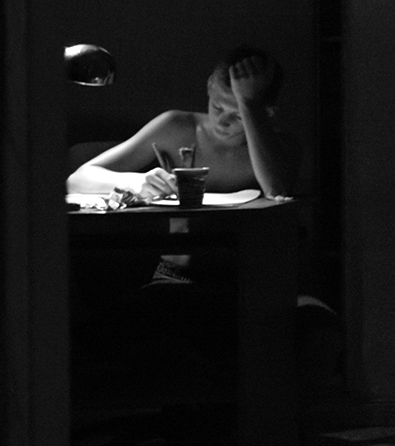
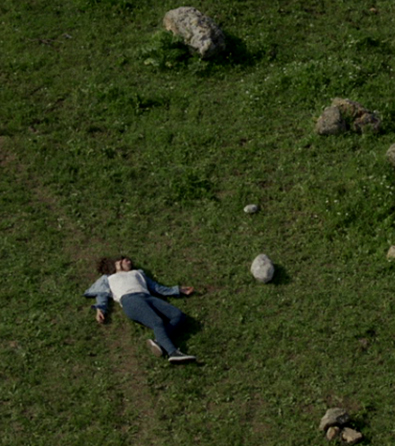
The short film Pomegranate Flower (18 minutes) is available at the top of the page.
* To watch this film, please approve YouTube/Vimeo cookies via the blue cookie icon at the bottom left of the screen.
The truly great short films are those that hold an entire world within them, engaging viewers intellectually and emotionally as fully as a feature-length film, and sometimes even more so.
Itamar Alcalay’s Pomegranate Flower (2020) is precisely such a film. Its synopsis describes it as a short documentary about a young man who visits his elderly grandfather, but it is, in fact, far more than that. Any attempt to situate it within conventional definitions or categories would simply do it an injustice.
Thematically, the encounter between Guy and his grandfather Eli brings questions of love, sexuality, family, belonging, loneliness, and migration to the surface, weaving them together with remarkable finesse. Aesthetically, this unique film is distinguished by a delicate, poetic, and hybrid cinematic language.
Itamar Alcalay is a highly regarded filmmaker in Israeli documentary cinema. The Camera of Doctor Morris, which he co-directed with Meital Zvieli, won the Best Israeli Film Award at the 2022 Docaviv Film Festival, while his short films have also earned awards and critical recognition. As in his other films, Pomegranate Flower reveals a deep understanding of film form and, above all, a genuine love of cinema. The film is layered with references to major films and filmmakers, some immediately recognizable, others more subtly embedded in its imagery. The film’s title, also the title of a love song Eli sings during the film, unmistakably echoes Sergei Parajanov’s groundbreaking Soviet avant-garde film The Color of Pomegranates (1969). Several images in Alcalay’s dream sequences are clearly inspired by Parajanov’s influential film and are rendered with striking beauty.
Another Soviet filmmaker who inevitably comes to mind while watching Pomegranate Flower is Andrei Tarkovsky. His films, too, are characterized by a spiritual atmosphere, recurring dream sequences, images of houses set in nature, and thematic explorations of migration, alienation, and childhood memory. The opening moments of Pomegranate Flower feel like a direct homage to Tarkovsky’s cinematic language, which, for anyone familiar with his work, is perhaps the highest compliment a film can receive.
At the beginning of the film, before entering Eli’s house, Guy pauses to take in the surrounding landscape, allowing himself to experience the rain and wind before the visit begins. The house itself is presented as a mysterious place, and the viewer is deliberately given no information about the city or the precise area in which it stands. It appears to exist in a liminal space, “neither here nor there,” in the middle of nowhere, somewhere between nature and the city. As the film unfolds, the house also seems suspended between dream and reality, and between past and future. This choice gives the entire film a surreal atmosphere and heightens the sense of dream and fantasy that permeates it. It, too, references the films of Tarkovsky and Parajanov, particularly the arrival at the house near the beginning of Tarkovsky’s Solaris.
Alcalay’s cinematic references are neither an artistic whim nor an attempt to impress. They are a deliberate choice, closely connected to one of the film’s most important elements: its reflexivity. From the outset, the director insists on exposing the cinematic apparatus and the constructed nature of filmmaking, repeatedly reminding viewers that they are watching a film. This reflexive dimension is especially apparent in moments when Alcalay asks Eli to gaze silently into the camera for several long seconds, or in the extended shot that places grandfather and grandson side by side without either of them speaking. It is also present in the prolonged shot of the wallpaper in Eli’s home, which becomes an absurd image of artificiality. The dated, peeling wallpaper depicts a landscape of snow-covered mountains, and the dissonance between the image and the house in which it hangs produces an effect that is comical and witty, yet also deeply sad. Throughout the film, Alcalay repeatedly draws attention to the ways in which he manipulates reality as he films and edits it.
In doing so, he underscores a fundamental formalist proposition: even the direct documentation of reality has its limits, and even documentary images contain elements of fabrication and deception. The truth that art seeks to reveal can emerge only through a range of aesthetic manipulations.
Such a choice is both bold and unusual. In documentary cinema, or at least in a film that presents itself as documentary and is therefore expected to show “reality” as it is, it is even more exceptional. In other words, its reflexivity positions the film along the spectrum between documentary and fiction, since many of the director’s techniques are more commonly associated with narrative filmmaking. This is why Pomegranate Flower is so difficult to define precisely as a conventional documentary. Indeed, it does not appear to seek definition at all.
The film is framed by brief, abstract dream sequences, while the visit itself is presented in a relatively conventional documentary mode. Yet even during the visit, Alcalay introduces unexpected ruptures into the forms and patterns to which we are accustomed. One of the film’s most surprising moments, and a striking example of its fusion of documentary and fictional techniques, is the scene in which Guy’s partner arrives in the middle of the night. As the two men kiss on the sofa, Eli sits in the adjacent room and criticizes them. His message is essentially: “You will regret every moment you wasted on each other instead of on a woman.” The scene is clearly staged, yet the way it brings the film’s central themes to the surface, including the generational divide, love and freedom, sexuality and masculinity, is nothing short of brilliant. A “documentary” scene in which Eli simply explained his conservative worldview to Guy could never have conveyed these ideas with the same beauty or emotional force. Nor could it have captured so vividly the tension inherent in the differences between grandfather and grandson.
Through hybridity and reflexivity, Alcalay draws the film’s various layers together. Just as dream and “reality” gradually merge within the walls of the house, cinema and reality become intertwined and ultimately converge. To my mind, the film’s originality lies in its ability to be several things at once: an abstract avant-garde film that uses surreal imagery to explore the subconscious; a nostalgic documentary record of migration and love; and a reflexive work that raises questions about cinema’s capacity to engage with reality, as well as the limits of that capacity.
Between dream and reality, cinema and truth, past and future, nature and home, Pomegranate Flower moves through several dimensions at once and refuses to define itself. This is precisely what makes it so distinctive and beautiful, and what makes watching it an unforgettable cinematic experience.