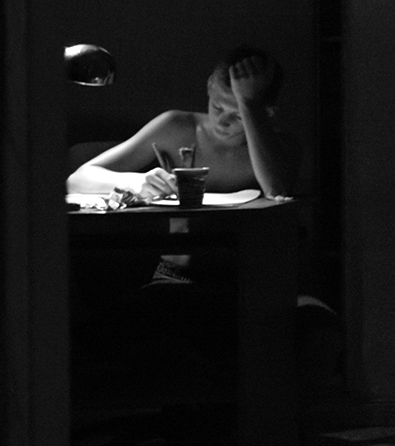
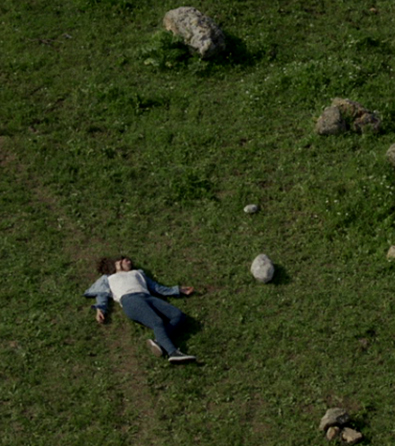
The video art Re-Collection (9 minutes) is available at the top of the page.
* To watch this film, please approve YouTube/Vimeo cookies via the blue cookie icon at the bottom left of the screen.
Nevet Yitzhak created her two animated works, Re-Collection and The Collector, for the Re-Collection exhibition at the Wilfrid Israel Museum (curated by Shir Meller-Yamaguchi, 2021). While watching the videos recently, two references came to my mind that I want to set down here.
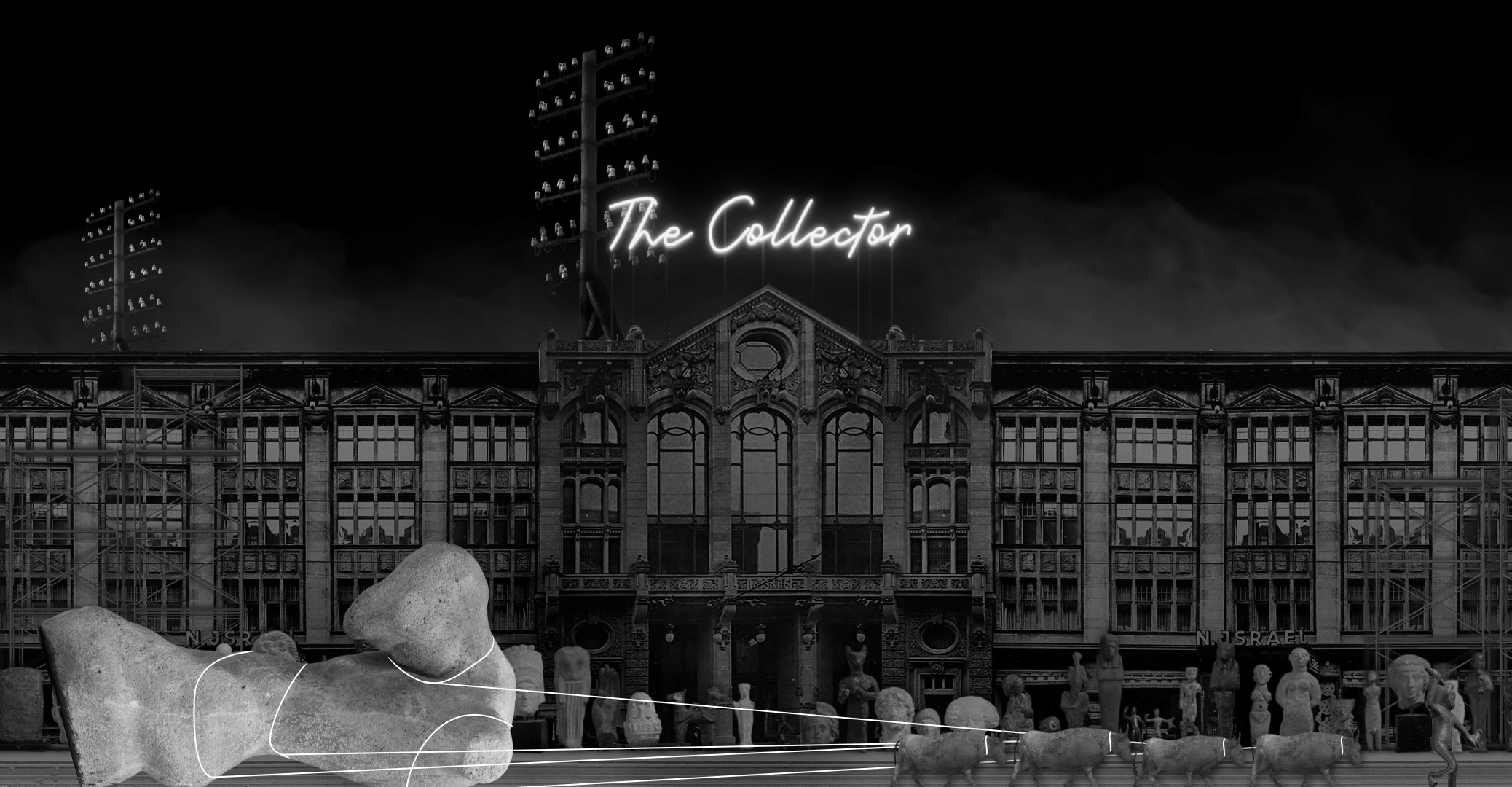
The first is the multilayered structure where Yitzhak stages one part of the collection’s story: an illusory space of her own invention, deconstructivist in essence. It echoes the disorienting zigzag that Daniel Libeskind, the Jewish architect, devised for the Jewish Museum Berlin, which opened in 2001. The second is the neoclassical façade on the plaza. In front of it, a portrait statue created by the collector has been toppled from its pedestal and dragged off toward some unknown destination. The image recalls the barge sequence in Theo Angelopoulos’s Ulysses’ Gaze (1995), where a statue of Lenin, a leader of the Bolshevik October Revolution, is borne along the Danube. That sequence marks the collapse of the Soviet Union and the waning of communist ideology.
Each reference marks, in its own way, a crossroads in geopolitical history where the established order is destabilized and invites a new reading. In Nevet Yitzhak’s animated works, architecture is not merely the space in which the story unfolds. It is the story. That passage, from neoclassical façade to deconstructivist structure, leads out of a museological order that fixes history in place and into a living memory that leaves room for doubt, for a second look, and perhaps for a new interpretation.
This is the story of the art collector Wilfrid Israel (1899–1943), who bequeathed the eclectic collection he had assembled to the museum that bears his name. At first glance, it is the personal story of a Jewish businessman, collector, and amateur sculptor who lived in Berlin between the two world wars. He inherited the family department store, acquired art objects on his travels through the Near and Far East, and was captivated by the passion of a group of young Jewish socialists who founded Kibbutz HaZorea in British Mandatory Palestine in 1936, today northern Israel. Visiting the kibbutz in 1940, he expressed his wish to join its founding group. The Second World War cut those plans short: his plane was shot down by the Germans and he was killed. His collection, sent to Britain before the war, was damaged in the Blitz on London. What remained of it was brought to Israel, where it became the founding core of the art collection at the museum built under the terms of his will between 1947 and 1951. The collection itself, then, marks a dramatic geopolitical crossroads, and it calls for a new reading.
I first encountered Nevet Yitzhak, who was born and educated in Jerusalem, during a gallery talk at the city’s Museum for Islamic Art, on the occasion of her exhibition Orient Express (curated by Sally Haftel Naveh, 2014). The exhibition rested on formidable research and drew on selected archival items recorded in black-and-white photographs. The photographs were scanned and became digital collages, which in turn developed into large-scale animation installations resembling traditional Afghan carpets, conceptually reworked with the digital tools then emerging. The installations War Craft were shown at Noga Gallery of Contemporary Art in Tel Aviv and at Yossi Milo Gallery in New York. The issues raised by her approach to presenting the collection have characterized her work ever since. Each time, she re-examines the mechanisms by which objects are gathered, classified, displayed, and read. Yitzhak unsettles hierarchies that have become entrenched over the years, and asks us to look at them again and weigh what they mean, at a moment when ownership, restitution, and memory are all being argued over in public.
The two animated works Yitzhak directed for the exhibition at the Wilfrid Israel Museum return us, each in its own way, to an earlier time, rooted in the pre-museum, colonial era. In that world, the finest plunder was put on display for the masses, along with the war prisoners taken alive and led in triumph through the city gates.
Architecture is central to both works, and the choice can hardly be accidental. Yitzhak is aware of the cultural and geopolitical weight carried by the neoclassical façade in The Collector and by the deconstructivist structure in Re-Collection, with all that this implies. One work reconstructs a neoclassical façade as the backdrop to what looks like a scene of expulsion. The other raises a geometric structure whose unorthodox spaces host performances that enact myths both recognizable and imagined.
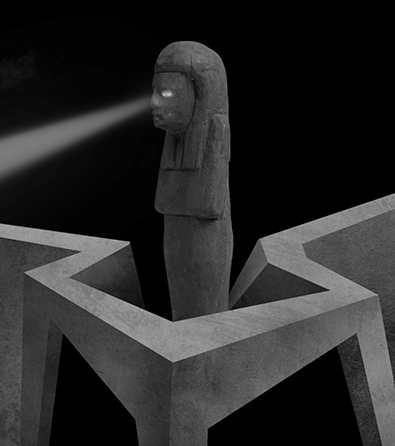
Re-Collection opens onto a vast space of exaggerated angles, where walls, staircases, openings, and passageways come apart and reassemble in constant motion. This is not a museum in any familiar or expected sense. The collection is not presented as an orderly taxonomy of objects but as a stage for a performance saturated with memory. Things disappear and return, gesturing toward the familiar mythologies of the objects’ countries of origin and toward invented ones, blurred and full of dread. A few examples: a Buddha’s head that rises and sinks again and again in churning water; an Egyptian wooden figure of a winged, armless maidservant; the head of a Roman statue with a fountain for a mouth; a flag bearing a broken rifle, the emblem of the Anti-War Museum that operated in Berlin from 1925 until the Nazis shut it down; torch-bearing messengers advancing through bare tunnels; chimneys with smoke curling above the compound. The very act of collecting no longer looks like an attempt to impose order and guarantee preservation. It has become a continuous process of taking apart, putting back together, and searching for a fresh interpretation. Here the architecture is both the setting for the action and a visual language, one that reopens the relations between memory, history, and identity.
Reading the work this way led me to the principles of deconstructivism in architecture, a style that emerged from postmodernism in the 1980s and drew largely on the ideas of deconstruction, the theory developed by the French Jewish philosopher Jacques Derrida (1930–2004). Advances in design and construction technology made the style possible in practice. Daniel Libeskind is among its most prominent figures. I am not arguing for a direct influence, or for architectural deconstructivism as a source of inspiration. What I want to propose is an intuitive reading: historical rupture and fragmented memory given the form of a labyrinth that offers neither clear bearings nor any lasting stability.
Yitzhak herself names Robert Wiene’s silent film The Cabinet of Dr. Caligari (1920), unmistakably German Expressionist in style, as a central inspiration for the design of the scene. The interpretation I am proposing points to a further echo, between the frenetic space she builds and the architectural language of deconstructivism. The passage from the neoclassical to the deconstructivist is not only a matter of form. It marks a profound shift in how we understand history, memory, and identity. Neoclassical architecture rested on order, symmetry, stability, and continuity, values meant to express a belief in a harmonious, unifying narrative. Deconstructivism gives all of that up and takes on doubt, rupture, discontinuity, and a multiplicity of viewpoints. Seen this way, Re-Collection is not only about a museum collection. It asks how memory itself takes shape out of fragments, erasures, and accretions, and it suggests that taking things apart is precisely what allows identity and history to be rethought in unexpected contexts.
Re-Collection concentrates on an illusory architectural space, one in which memory is unsettled, dismantled, and reassembled. The Collector turns its attention to a performance staged before the imposing façade of the Berlin department store the collector inherited. That façade references the neoclassical front of the Altes Museum (1830), located on Berlin’s Museum Island and characteristic of nineteenth-century museums. Designed by the renowned German architect Karl Friedrich Schinkel (1781–1841), it stands as a landmark of its era.
In The Collector, objects from the collection are lined up along the neoclassical façade like a formation of witnesses, while the god Zeus and four bulls haul the unwieldy torso toward an unknown destination. The statue, a self-portrait by the collector, is no longer a fixed monument on a pedestal but a remnant of the past. Uprooted from its pedestal and dragged away from the symmetrical façade, it ceases to be an emblem of authority and permanence. It becomes an object subject to movement, to renewed exposure, and to shifting interpretation.
The two works Nevet Yitzhak created for the Re-Collection exhibition address the fate of Wilfrid Israel’s collection. I suggest they do something more intricate: architecture serves not merely as a setting for events but as an interpretive language. The passage runs from the neoclassical façade of the Berlin department store to the deconstructivist structure, where the historical account comes apart and is built anew. The echo between the two spaces lets us interpret her work not only as an engagement with one particular collection but as a broader contemplation of the visual methods of memory representation.