The short film Cold Frost & Sunshine (18 minutes) is available at the top of the page.
* To watch this film, please approve YouTube/Vimeo cookies via the blue cookie icon at the bottom left of the screen.
The short film Cold Frost & Sunshine, directed by Hila Elena Royzenman and produced at the Sam Spiegel Film and Television School in Jerusalem, is composed of collisions between opposites. It brings together warmth and coldness, understood as contrasting personality temperaments, a tension to which the film’s title also alludes, as well as the elevated and the ordinary, the poetic and the mundane, or, in other words, poetry and reality.
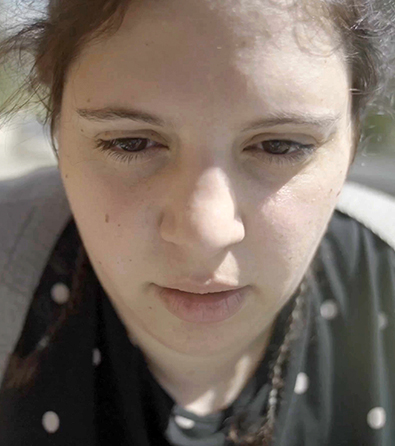
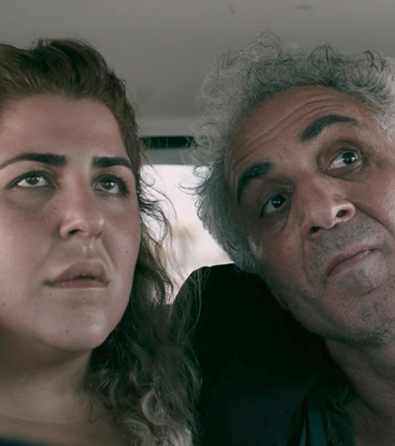
The film’s narrative unfolds within the walls of a high school in a disadvantaged neighborhood of Jerusalem, centering on the unusual bond that develops between Margarita, a lonely librarian who emigrated from the former Soviet Union, and Nehorai, a troubled student from an unstable home.
The narrative link between these two characters crystallizes the film’s core dynamic: the convergence of worlds that at first appear distant and incompatible, yet whose interaction, or friction, produces a distinctive emotional spark. Cold Frost & Sunshine observes this spark through a restrained and realist cinematic language, simple in the best sense of the word, and marked by compassion and profound human empathy, even when its characters act in contentious ways.
The film opens with a scene of poetry recitation inside a crowded bus, offering an early demonstration of its careful use of contrasts and of the encounter between the “elevated” and the “ordinary.” Poetry is inherently estranged from everyday language and speech, and by situating poetic expression in what is arguably the least “sublime” setting, the film accentuates this sense of otherness. The opening montage, which lingers on the weary and silent faces of the passengers, exemplifies the film’s recurring effort to locate the poetic within the earthly and the sublime within the mundane.
In the following scene, a group of teenagers sits in the school cafeteria, speaking in a language as far removed from poetry as one could imagine, a deliberate choice that further sharpens the contrast between poetry and everyday life.
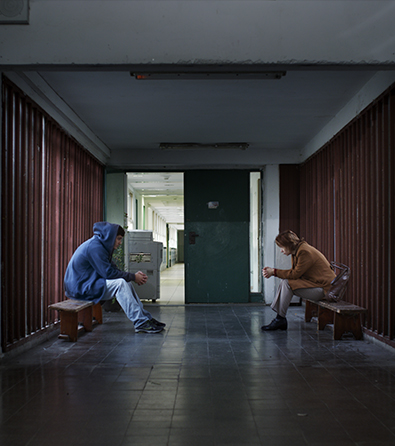
In contrast to the opening scene, where Margarita and Nehorai stand side by side closely and appear, if only momentarily, to bridge the gaps and oppositions the film continues to explore, the final shot is more somber and striking. The long, static shot presents Margarita and Nehorai seated opposite one another, almost as mirror images. They are physically distant, enclosed by bars that frame them as trapped in the harsh, unforgiving reality of their lives, with no apparent possibility of escape. In this sense, the final scene, set in an empty corridor, functions as an inversion of the opening scene on the crowded bus. It is a dark and pessimistic conclusion, whose impact is intensified by the gentle optimism the film has offered up to this point, an optimism that suggested the possibility of change, transformation, and release from the constraints of daily hardship.
Relationships between teachers and students have become a prominent theme in contemporary Israeli cinema. Acclaimed films such as Scaffolding and Unseen by Matan Yair, as well as Doubtful by Eliran Elya, are notable examples among many recent Israeli works that engage with this subject. Like many of these films, Cold Frost & Sunshine offers a sharp critique of the Israeli education system, portraying it as one that prioritizes grades and measurable outcomes over genuine education and attentive listening. This critique is articulated through the contrast between Margarita’s approach to education and that of Limor, the teacher, even as the film makes clear that Limor herself is also a “victim” of the broader system and is portrayed with compassion rather than judgment.
Another work the film echoes, in my view, is The Kindergarten Teacher by Nadav Lapid, despite the clear differences in cinematic style and narrative detail. As in Lapid’s film, Royzenman’s short film centers on a female protagonist who goes too far in pursuing a form of wishful thinking, or fantasy, about her ability to help another, more vulnerable character who is perceived as failing to realize their potential. In both films, the bond between the characters is rooted in a shared love of poetry and poetic talent. In both cases, the figure who seeks to help fails to recognize that she is crossing the boundaries of what is legitimate, perhaps driven by an unconscious attempt to save herself and to ease her own sense of despair and loneliness.
Through a realist and distinct cinematic language, and a narrative that is simple and intelligent, the short film Cold Frost & Sunshine succeeds in sketching a touching portrait of the collision between fantasy and reality, and between the poetic and the sublime on the one hand, and the mundane and the earthly on the other. This collision, which is part of our lives in Israel and beyond, is often painful and sad, yet it also creates sparks of grace and beauty, toward which the film directs its gaze.