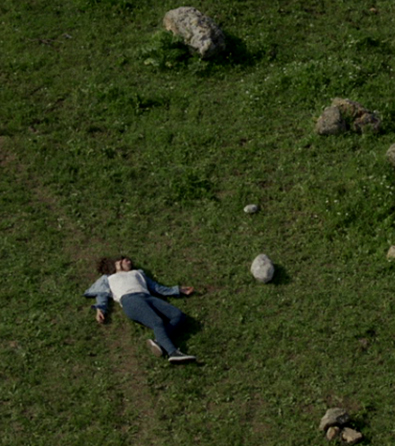
The short film I Couldn’t Know (7 minutes) is available at the top of the page.
* To watch this film, please approve YouTube/Vimeo cookies via the blue cookie icon at the bottom left of the screen.
I Couldn’t Know, directed by Elkie Leonie Hershberg, is a short film that leaves you heavy-hearted. At its center is an apparently simple physical drama: one body, one sustained movement, and an unyielding gaze that refuses to let go. The Israeli poet Nathan Zach’s poem that opens the film sets the tone, asking us to slow down and look closely at a moment that may have slipped past us, close enough to brush the hem of its cloak, and yet left untouched.
The opening quotation from Zach’s poem is not a literary ornament but an ethical and aesthetic touchstone. “One moment, quiet, please” is both an appeal to the viewer and a statement of the film’s structuring principle: it slows time down, holds the gaze in place, insists on looking. The poem circles missed moments, not knowing, and responsibility left unmet. Hershberg carries that impulse from language into the body. Deborah, a young, plus-size Ultra-Orthodox Jewish woman, “does” almost nothing in conventional narrative terms. She walks. Yet the walk, with a walker, becomes a charged, chilling passage in which each step is labor, and each effort sharpens the same questions: Who sees? Who knows? Who could have stopped?
The cinematography by Boaz Yehonatan Yaakov and the precise editing by Shira Meishar resist overt dramatization. There is no manipulative score, no sharp cutting to offer the viewer relief. Instead, the film builds its drama through repetition and through the brute clarity of sound: the rasp of friction, sneakers scuffing on asphalt, the rising sun, the heat, the heavy breath. It is a cinema of bodily exertion, almost Sisyphean, in which the protagonist’s body carries both its physical weight and the symbolic weight of loneliness, social invisibility, and the absence of human touch. Rina Reim carries the film with a performance that is both fearless and vulnerable. Her acting is not psychological but physical: gaze, breath, rhythm.
It is precisely the absence of dialogue that sharpens the film’s sense of responsibility. If anyone in Deborah’s orbit had cared, her path might have changed. Instead, the surrounding silence and the anonymity of public space become complicit in neglect. Zach returns here not only as a quotation but as a governing thought: “Who could have known what I did not know?”
The film’s ending, in which Deborah moves toward the railway tracks and watches a train rush past, invokes another literary source: Anna Karenina. Yet it does so with remarkable restraint. There is no reenactment, no romantic staging of death. The train is not a melodramatic emblem, but an indifferent industrial force, passing through. If in Tolstoy the act carries a vast social, emotional, and romantic charge, here it narrows to an almost purely physical gesture, without witnesses. The reference to Anna Karenina clarifies the difference: not a grand, publicly narrated tragedy, but a quiet, nearly invisible death embedded in ordinary life.
Part of the film’s distinctiveness lies in its refusal to foreground overt Ultra-Orthodox cues. Deborah is Ultra-Orthodox, but the film refuses to make that identity “the subject.” It does not frame itself around institutions, ideology, or an explicit religious conflict. Instead, her Ultra-Orthodox demeanor is allowed to remain a fact rather than an explanation. The effect is to widen the frame: this is not an “Ultra-Orthodox problem,” but a universal human drama about a body read as out of place in public space, about social invisibility, and about how entire communities learn not to see.
I Couldn’t Know is a short film, yet its echo lingers long after it ends. It not only seeks understanding; it presses the viewer toward ethical and emotional self-examination. After the train has passed, where were you standing, and could you have stopped, even for a moment, to ask? In a wider frame, I Couldn’t Know belongs not only to Hershberg’s singular voice, but to a wider and increasingly consequential movement in contemporary Ultra-Orthodox cinema, and especially to the work of Ultra-Orthodox women filmmakers, who are redrawing the boundaries of representation and cinematic language.
One defining feature of women-directed Ultra-Orthodox cinema in Israel is a production model that brings together community-based financial independence with spiritual oversight that grants internal legitimacy. In terms of funding, many directors rely on a personal bank loan, private family investment, and a direct distribution model based on advance ticket sales and designated screenings at women-only social events, held in auditoriums, seminaries, community centers, or other community settings. Screenplays, images, music, and successive cuts are reviewed or presented to their community’s authority figures to ensure the film meets standards of Halakha (Jewish law), modesty, educational messaging, and a faith-based spirit. This creates a cinema that exists almost without an external gaze and without any need to explain itself to audiences beyond the community: it is produced, examined, approved, and screened from within, for Ultra-Orthodox women. Its aesthetic is not only an artistic choice, but the outcome of an ongoing negotiation between narrative and a faith framework that seeks to preserve meaning, boundaries, and purpose.
Until a decade ago, Ultra-Orthodox women in Israeli cinema were seen largely through an external gaze. The films were “about” the Haredi world rather than created from within it. They tended to lean on social exoticism, overt clashes with institutions, or narratives of departure from the Ultra-Orthodox community, as well as on themes of sexuality. Over the past decade, with growing momentum and the rise of dedicated programs for Ultra-Orthodox women filmmakers, another form of filmmaking has emerged. This Ultra-Orthodox cinema is intimate and minimalist. It forgoes educational or faith-based explanation; instead, it makes room for experience, the body, time, and silence.
I Couldn’t Know clearly belongs to this current, even as it refuses to announce itself as an identity statement. Its dramaturgical decision to avoid overt Ultra-Orthodox cues (religious discourse, institutional spaces, open conflict with authority) is not an erasure of identity, but a subtler shift: letting Ultra-Orthodox register not as ideology, but as bodily experience. In Deborah’s body, the experience of living inside a dense normative order takes shape, without being spelled out.
I Couldn’t Know is part of an Ultra-Orthodox cinema that does not seek to “explain itself” to a secular viewer. Instead, it asks the viewer to watch, to linger, to tolerate discomfort. In this context, choosing a dialogue-free physical drama acquires a deep political and aesthetic force. The body bears meanings that resist paraphrase, creating an image that is both symbolic and concrete. Deborah’s walking, the dragging of her feet, and the film’s insistence on strain articulate an Ultra-Orthodox woman’s experience without confession or declaration. It is a cinema that replaces “statement” with “presence.”
Here, the context of the A-Kitzer (In Short, in Yiddish)project also comes into play. Supported by the New Fund for Cinema and Television and led by director and creator Rachel Elitzur, A-Kitzer serves as a unique incubator for short work by Ultra-Orthodox women. It is not merely a production framework, but a creative space that allows these filmmakers to test the limits of time against storytelling within the short-film form, while avoiding unnecessary explanation or cultural apologetics.
I Couldn’t Know sits within a broader current among women filmmakers drawn to threshold states: between childhood and adulthood, body and spirit, community and solitude, violence and redemption. Its use of literary touchstones, poet Nathan Zach and Anna Karenina, gains added resonance in the context of Ultra-Orthodox women’s cinema. These are not classical Jewish sources, but part of the Hebrew and universal canon. Choosing them marks a turn toward a wider cultural conversation, without surrendering what is distinctive in the filmmakers’ voice.
This cinema claims its place within Israeli and global film culture, not as an exotic outlier but as a voice among others. It offers less of a “correct” representation than a cinematic encounter that assigns responsibility to the viewer: the responsibility to know, to ask, to pause. In that sense, Deborah is not the film’s only subject. The film is about the viewer’s gaze.