The short film Turn Over the Stones (29 min) is available to watch at the top of the page.
* To watch the film, please enable YouTube/Vimeo cookies through the blue cookie icon at the bottom of the page.
First comes the sound of wind over a black screen.
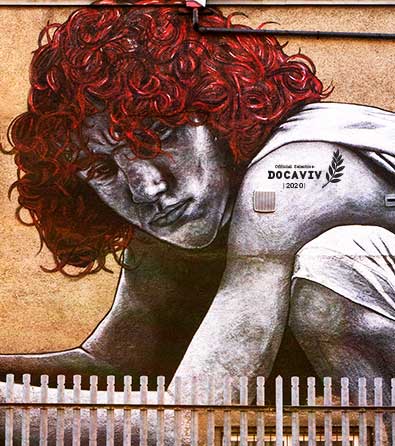
Then, a drawing hanging on a wall: a kiss encircled by a swirling black line that throws it into turmoil. The film’s first image.
Then, a stone. The second image.
The three elements that open Nir Dvortchin’s short film Turn Over the Stones (2016) already reveal a distinctive quality that runs throughout the film: the ability to distill reality into its essential materials, ideas, and emotions; to resist human curiosity and voyeurism, or perhaps to harness them to tell a different kind of story.
One can imagine how different this film, which follows a man who served prison sentences across several European countries before settling in the Negev Desert in Israel, might have been in the hands of another filmmaker. We would likely hear, in detail, about the crime for which the protagonist, Shimon (Sami) Shitrit, paid his debt to society; how he came to be imprisoned in Europe and why he was transferred between prisons in Spain and France; what brought him to Margarita Island in Venezuela; what eventually led him to establish a farm overlooking the desert landscapes near Mitzpe Ramon; and who exactly was Cochava, to whom the letters recited throughout the film were addressed.
Dvortchin’s artistic decision to leave these questions unresolved, while turning his attention instead to Shitrit’s experience of the desert, justifiably earned the film its premiere at the International Documentary Film Festival Amsterdam (IDFA) and the Best Student Film Award at Docaviv. It is a choice that allows the film to move beyond the boundaries of Shitrit’s personal story, entering into dialogue with biblical and mythical motifs while touching on fundamental questions of human existence and the fragile space between culture and nature, between the human and the animal. The title Turn Over the Stones hints at the broader experiences explored throughout the film: the longing for repair, the desire to transform harsh surfaces, and the daily Sisyphean labor embedded within those aspirations.
Yet Dvortchin does not sacrifice Shitrit as an individual upon the altar of the poetic and the universal. The cinematography by Anatoly Rachenko approaches the desert recluse with deep humanity and empathy, lingering on the lines etched across his face, his relentless physical labor, and the unexplained smile that briefly appears late at night. Our sense of intimacy with Shitrit does not emerge from an extensive understanding of his biography, but from the cinematic gesture itself, from the representation of the body, and from the intimate recording of his voice reciting reflections from both past and present. And just as Shitrit tends to perceive symbolism within the reality surrounding him, the film remains deeply attentive to its central figure and to the inner world he generously reveals.
In the opening sequence, Shitrit’s narration focuses on the desert wind, which serves as the film’s soundtrack. His descriptions of the whistling wind as a demon reveal the richness of his language while granting the wind an almost mythic, superhuman presence. When he speaks of the wind giving wings to one’s ears, he evokes a sense of freedom. When he describes its growls, audible only because the desert holds enough silence for them to be heard, he hints at an inner terror.
Even before Shitrit’s voice is heard, the film introduces his farm. It is a space that immediately provokes curiosity, filled with heavy wooden furniture and unusual decorative objects, including empty frames, colorful fabrics draped across the walls and ceiling, a jacuzzi bathtub, and countless stones serving various purposes. No human is in sight. Only a cat and a dog wander through the structure and the sun-soaked desert landscape surrounding it. When Shitrit finally enters the frame, he is filmed from afar, sitting motionless and nearly absorbed into the open landscape, among truncated trees and discarded car seats scattered across the terrain. First the cat, then the dog, and only then Shitrit. A man amongst nature, a man amongst the animals.
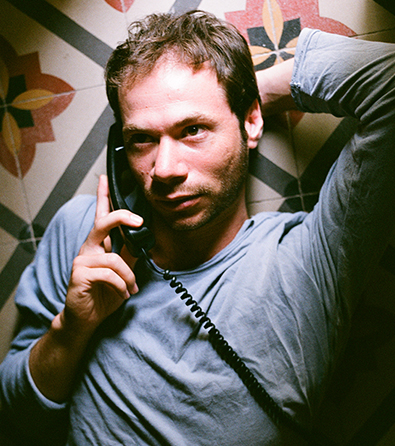
Shitrit walks across the vast terrain, kicking and rolling stones, perhaps absentmindedly, perhaps with great concentration. In his hand is a hammer he uses to carve into a cave that, in another era, might have sheltered monks or desert ascetics. His tongue protrudes from his mouth with the intensity of the effort, sweat running down his deeply lined face. From there, the film drifts into the continuation of his daily routine. Considering the turbulent life that quietly emerges between the lines of Shitrit’s narration, it feels almost audacious on Dvortchin’s part to devote extended screen time to scenes of Shitrit peeling an apple with a knife and eating, or lying on his back gazing upward while a gentle light washes over his face. May there be more documentary films in our midst with this degree of audacity.
Even in a letter Shitrit sent to Cochava in 1991 from the prison of Daroca in Spain, recited in voice-over, the focus remains on everyday life: desert heat and cool winds, Sami waking up in the morning “without stress, with no need to rush anywhere.” There is no need even to clean the cell. Breakfast consists of hot chocolate, bread with butter, and cake. Afterwards, he sits in the sun eating fruit. The surprising idyll that emerges from his descriptions of prison conjures a life more peaceful than the one he leads after gaining his freedom. True, both there and here the desert wind remains, and there is fruit to eat. But the hard labor, the endless carving into stone, raises another question: to what end? Did he ever truly release himself from imprisonment?
The second letter recited in the film, this time from Châteaudun Prison in France in 2001, presents a far less idyllic reality and draws us deeper into Shitrit’s pain while simultaneously unsettling the viewer’s trust in descriptions of reality. It is early morning, and throughout the surrounding prison cells, his family is scattered around him: his brother Pinhas sleeping above him, his parents in one cell, his two young daughters in another, and in the last cell, Cochava, the recipient of the letter. He asks his brother for an alibi, kisses the girls, and is drawn into Cochava’s embrace until he awakens to the guards’ morning wake-up call, alone, “within the infinite stretches of the universe.”
Against this backdrop, the film shows Shitrit wandering through the open terrain, digging and clearing stones with restless gestures until the sun sets. Only the cat and the dog remain beside him. The drawing of the kiss from the film’s opening shot begins to take on flesh through the descriptions of his love for Cochava, and we are left wondering how the winds of life carried Shitrit to this isolated place, where Cochava is now, where the girls are today. A new day rises, accompanied by a voice seemingly drifting out of the letter: “Attention Ramon Prison inmates, attention Ramon Prison inmates, roll-call is over.” We discover that just across the road, only a short distance from the farm, stands a prison facility established in 2006. Dvortchin’s decision to link past and present through the blending of prison announcements returns once again, hinting at the way these layers remain intertwined deep within Shitrit. It is difficult to believe that he chose to build his farm beside a prison merely by coincidence.
The third letter takes us further back in time, to 1989, reminding us once again that chronological or biographical continuity is not the film’s artistic concern. The decision to move freely between different time frames evokes a consciousness drifting through memory, while deepening the journey into Shitrit’s suffering. His words describe becoming lost in despair and fear, withdrawing from those around him inside the prison.
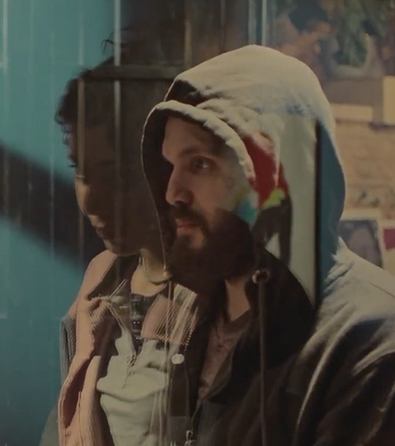
As these words are recited, Shitrit is shown striking a handmade gong bell that evokes images of Buddhist monks. He gathers herbs, chops vegetables, his face covered by a thick beard. The scenes appear to take place during the Counting of the Omer. In the background, a recording of prayers from the “Tikkun HaKlali” is heard, the collection of Psalms selected by Rabbi Nachman of Breslov for those seeking atonement for sins and transgressions. As Shitrit continues working in the kitchen, his reflection in a mirror splits into two figures standing side by side, like twins, a visual expression of the fractured soul of a man who describes speaking to himself in prison, a madman, in his own words, fully aware of his madness.
The final third of the film brings its exploration of the meeting point between body and soul, matter and spirit, to its fullest expression. In a fourth letter, written on Margarita Island in Venezuela in 1998, during the period between his imprisonment in Spain and France, Shitrit describes with remarkable poeticism a desire emerging from asceticism, the shedding of the body, and rebirth:
“My body. The one that was overfed and suppressed and drugged, danced and capered, withered and melted, stripped of humanity, skin, muscle, and bone. Dissolved in water and evaporated, boiling into the air […] waisting away with the seasons, but always returning to bloom in springtime.”
Here, the figure that until now resembled a Sisyphean laborer of desert stones begins to undergo a process of physical purification. Shitrit shaves himself clean like a healed leper, scrubs his body with soap, and bathes in boiling water heated in pots. Wrapped in a tallit, the traditional Jewish prayer shawl, he prays before the endless expanse of the desert. A solitary human body facing nature, seeking forgiveness.
Yet religious purification and renewal are not the film’s concluding chord, for the human condition that emerges from it is far more tangled and complex. In the narration that closes the film, Shitrit returns to the wind, describing how it carries to him the nightly screams of his neighbors from Ramon Prison like voices haunting him from the past.
“My neighbors in prison are the cruelest monsters of this generation,” he says in narration. “I recognize their faces. I know them. I understand them. I have to put them to sleep, so I can fall asleep myself. Because those monsters are also in me, too. Deep inside me, too.” Shimon (Sami) Shitrit passed away in 2025 after a prolonged battle with cancer. Turn Over the Stones, which preserves his memory, offers a glimpse into his talents and into an inner world that was deeply human, fractured, and profoundly complex. One may hope that he found release from the demons that haunted him. And perhaps, within the patient silence the film invites, viewers may find themselves reflecting on their own prisons, the monsters within them, and the stones they long to turn.