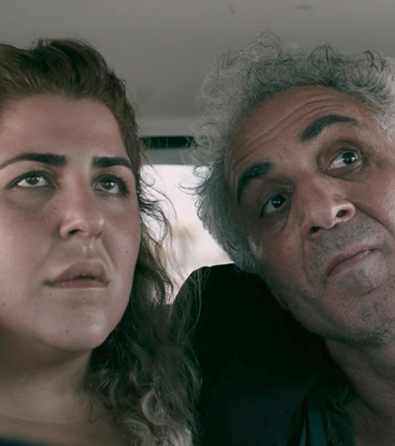
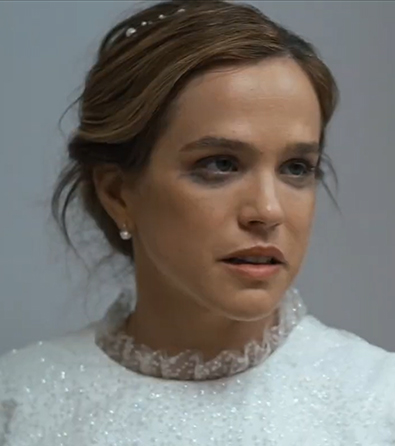
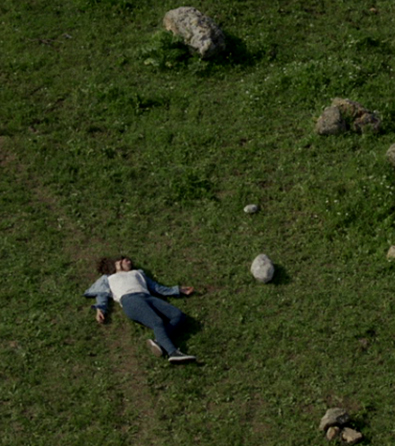
The short film Midnight Red (27 minutes) is available at the top of the page.
* To watch this film, please approve YouTube/Vimeo cookies via the blue cookie icon at the bottom left of the screen.
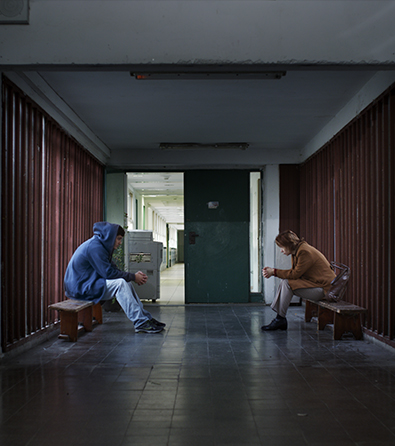
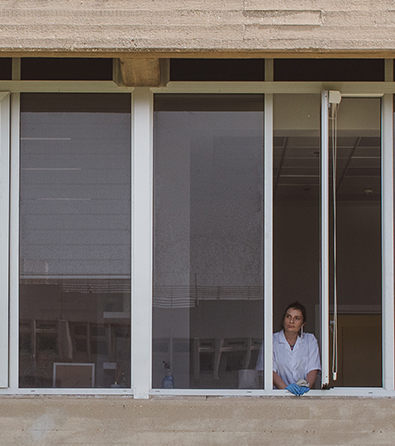
The short film Midnight Red (2024, Jalal Masarwa) unfolds entirely within an art gallery in a small Arab village in Israel and is presented in cinematic real time across its 27-minute duration.
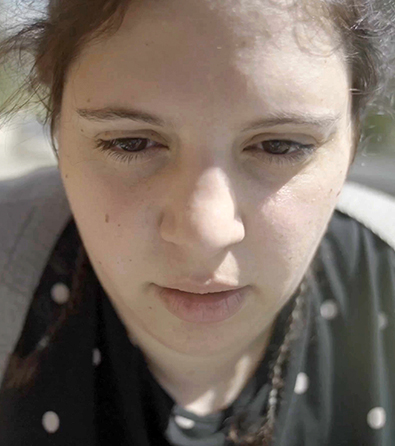
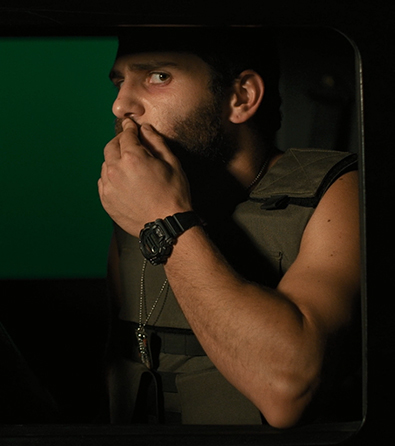
The story begins with Siwar, a young Arab woman working at the gallery, finishing her shift. As she locks up for the night, a mysterious stranger suddenly appears at the entrance. From that moment on, the film shifts its perspective. While the narrative remains intimate and tightly focused, it gradually expands, building into an increasingly tense and gripping experience.
In essence, this is a genre film: a well-crafted thriller that gradually reveals the different layers of its story. At the same time, the film remains deeply engaged with a subject of profound urgency and relevance: the phenomenon of “honor killings,” most often the murder of women accused of bringing shame upon their families in Arab society. It is precisely by framing these events through the conventions of a thriller that the film turns what might otherwise be perceived as an internal issue within the Arab community into one that broader audiences can grasp and respond to with empathy. In other words, by drawing on the language of cinematic suspense, Midnight Red brings attention to the long-neglected phenomenon of honor killings in particular, and to the rising violence in Arab society more broadly, presenting it not as an issue confined to one community, but as a reality that concerns us all as citizens of the same country.
The first striking feature of the film is its use of a single continuous take. The one-shot may no longer feel especially novel, given how many films have embraced the technique in recent years. Even so, an unbroken sequence remains a powerful way of shaping narrative and revealing its deeper structure. A particularly memorable example from recent years is the Israeli short film White Eye (Tomer Shushan, 2019), which was nominated for an Academy Award. Set in the “backyard” of South Tel Aviv, Shushan’s long take exposed the lived reality of African refugees, their own internal class divisions, the injustices they face, and the tensions between them and the Israelis living in that part of the city. Like White Eye, Masarwa’s film uses the one-shot to uncover layers of local reality and present it “as it is,” with the greatest possible directness and realism.
Long takes of this kind demand extensive preparation. This is especially true in a film like Midnight Red, where the camera is constantly in motion and the composition keeps shifting. Such a method requires careful coordination between actors and crew, as well as a high level of technical control. Filming a work of this length in a single take is no simple task. That is precisely why it is worth asking what leads filmmakers to choose this form.
In the case of Midnight Red, the continuous take gives the film two clear qualities. First, it heightens the tension and creates a stronger sense of realism, making the experience more emotionally affecting. Second, it allows the filmmakers to move between the perspectives of different characters, each representing a different approach to the charged conflict at the film’s core. In this way, the complexity of the situation comes into sharper focus, as does the difficulty of finding the right way to confront it.
Another significant artistic choice is the decision to situate the story within an art gallery. The setting gives the film a self-reflexive dimension, foregrounding its status as a work of art. As the characters and the camera move among the works on display, some of which appear to engage with political and even feminist themes, the film reminds us that while it engages with reality, it is not reality itself. At the same time, the gallery comes to symbolize a space shaped by freedom of expression and by liberal, inclusive values. In this sense, it stands in stark contrast to the conservative and violent world the film portrays, a world that ultimately forces its way into the gallery.
The film’s closing composition, which presents the bound figure framed twice over within the gallery doors, also reflects the film’s intelligence and sophistication. The character, who comes to embody the very issue the film confronts, appears within the doorframe like one of the artworks hanging on the gallery walls, enclosed by the rectangular lines of the frames and beams around him. It is a powerful, self-aware, and compelling image, one that once again reminds viewers that they are watching a film, a work of art that engages with reality and calls for action beyond it.
At the heart of this important film lies the ancient phenomenon of “honor killings,” alongside the broader issue of increasing crime in the Arab community, a reality that has grown both more extreme and more widely acknowledged, yet remains marginal. There are very few films, whether short or feature-length, that engage with these subjects. Perhaps this absence reflects a broader lack of films that confront the lived reality of Arab communities in present-day Israel more generally. For that reason, Midnight Red emerges, in my view, as an exceptionally significant film, one that is also artistically and cinematically compelling, sophisticated, and nuanced.
When watching a film like this, it is worth bearing in mind the tremendous courage it demanded of the actresses, the crew, and the filmmakers, who come from within the conservative society the film portrays. One can only hope that it will reach viewers from all parts of Israeli society and deepen their awareness of the urgent social issue it lays bare.