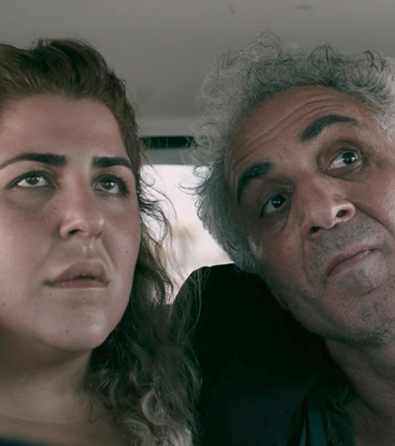
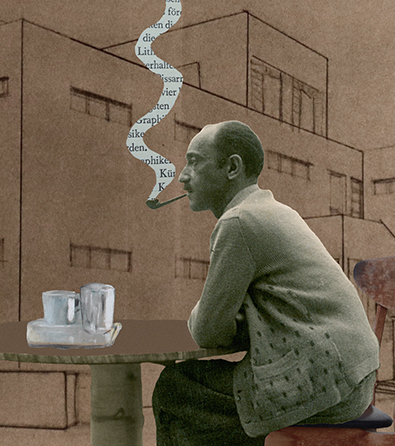
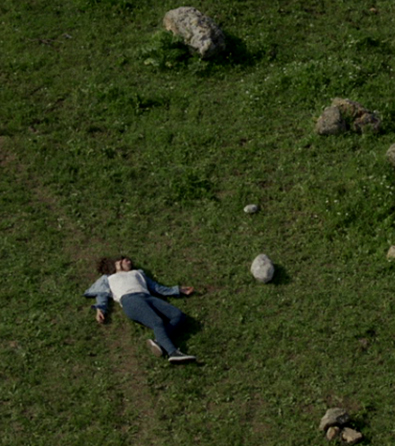
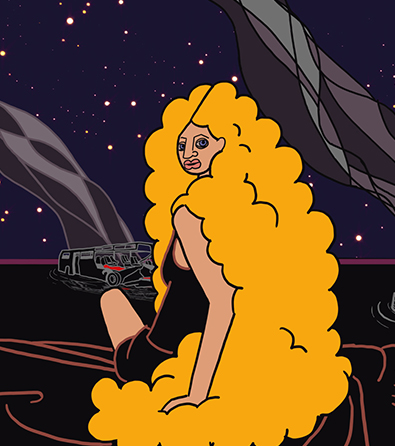
The short film Chérie, Combien Je T’aimee (3.5 minutes) is available at the top of the page.
* To watch this film, please approve YouTube/Vimeo cookies via the blue cookie icon at the bottom left of the screen.
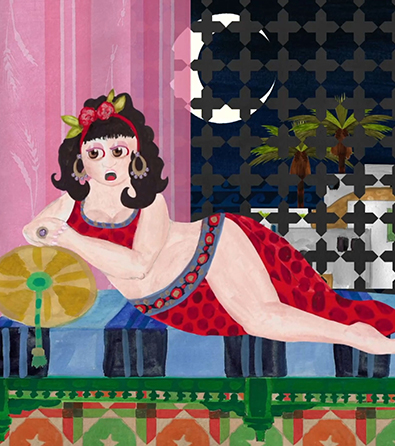
The odalisque reclines on a plush chaise longue, dressed in rich fabrics, in a scene evoking the seductive Orientalist imagery of the late nineteenth-century Ottoman harem. Behind her stands a barred window, through which a cultivated orchard is subtly suggested. The orchard emerges as a space of imagined desire and freedom, yet one simultaneously marked by surveillance and a voyeuristic gaze. She sings a love song to an elusive beloved. The song unfolds as an emotional monologue moving between disappointment and vigilance, between flirtation and a growing assertiveness. As the performance progresses, her attire gradually shifts from Oriental dress to Western clothing. It culminates in a moment when she openly reveals a hand holding a cigarette, a provocative gesture nearly inconceivable for a woman within the social and historical milieu being evoked.
The performance opens with an evocation of the iconic figure of Charlie Chaplin. The reference appears both in the figure’s appearance and in the rhythmic movement derived from the nonsense song Titina (1917), widely associated with his film Modern Times (1936). The figure moves horizontally across the front of the stage, at times discreetly observing the action unfolding there. Its presence is not incidental. It functions as a mediator, a witness, and at times as a voyeur. Through this playful presence, the performance signals the tension between tradition and modernity, between a crumbling old world and the seductive promise of freedom.
Through this vision, Eliahou Eric Bokobza (born in Paris, 1963) recounts one of his grandmother’s stories. It traces her coming of age as a young girl within a conservative Muslim–Jewish community in Tunisia. Her stories, imbued with moral lessons, served as testimonies of their time, carrying both warning and defiance. She would recount them to her grandson when he was entrusted to her care during the family’s visits to Paris. The personal narrative is thus embedded within a theatrical and aesthetic framework, in which memory operates as audio-visual raw material.
The animated work My Beloved, How Much I Love You (Chérie, Combien Je T’aime, 2022) was created for Bokobza’s monumental solo exhibition, A Family Affair (curator: Dr. Sharon Laor-Sirk). The exhibition was presented at the Museum of Islamic and Near Eastern Cultures in Israel. It traced the history of the Bokobza family through the perspective of a third-generation descendant. The narrative begins with the Jewish community of Tunis and the conservative Muslim society that surrounded it. It then follows the family’s move to Paris in 1962, after Tunisia’s independence and the rise of antisemitism, including riots against the Jewish community. For the family, Paris became a modern and influential center of culture and art. The narrative culminates in immigration to Israel, a multi-cultural society, seen through the eyes of a six-year-old child arriving in the reality of the melting-pot ideology and its failed implementation.
Bokobza’s early artistic trajectory unfolded on the margins of the local art scene. He is a painter working in a naïve artistic style and currently lives and works in Tel Aviv. His practice developed at a time when figurative and naïve styles were largely excluded from the canon. The dominant discourse favored minimalist and lyrical abstraction. It later gravitated toward the artistic tendency consolidated under the term The Want of Matter, as articulated in the iconic exhibition curated by Sarah Breitberg-Semel (1986). In contrast, Bokobza’s paintings were deliberately aligned with a Mizrahi aesthetic. They are vibrant, densely composed, and richly detailed, drawing upon an Oriental formal and visual vocabulary, particularly Tunisian artistic traditions.
In continuation of his grandmother’s stories, Bokobza also recognizes ongoing reciprocal influences between East and West. This dynamic is particularly visible in the Parisian spheres of fashion and art, as reflected in the works of Paul Poiret, Eugène Delacroix, Henri Matisse, and others. This conception of reciprocity, in which diverse cultural identities are shaped through friction and mutual exchange, recurs throughout his work. It is especially evident in his self-portraits from childhood and adolescence. The wide, open eyes, a hallmark of his painting, confront the viewer with an intensity that resists evasion. They function both as a gesture of resistance to exclusion and as a demand for recognition of a network of cultural affiliations.
Over the past decade, Bokobza has turned to short, animated films to animate painting through Middle Eastern sound drawn from Tunisian musical traditions. He also incorporates movement in time, giving the work an Orientalist, theatrical quality, akin to a contemporary One Thousand and One Nights. In this way, the viewing experience is expanded and deepened, while the painterly dimension of the work remains intact.
One should not, however, be misled by the apparent lightness of the vivid palette and the abundance of detail. Behind every image, object, and still life lies a deliberate layering of family memory, gender identity, and an ongoing engagement with a charged private and national history. Bokobza guides the viewer through the aesthetic surface toward a moment of wonder. This moment suspends the inevitable confrontation with contested representations, as well as with pain, frustration, and a nostalgia that is both consoling and wounding.
In this animated film, Bokobza returns to what is framed as the “scene of the crime” of his family history, and, to some extent, of national history as well. He revisits the early encounters between tradition and modernism in Tunis, particularly within the Jewish community. The film turns to a past he did not experience firsthand, but one passed down through the stories of his grandmother, the heroine of the film, embodied in the figure of the Jewish-Tunisian singer Louisa Tounisia (1905–1966). Louisa sings a seductive cabaret song to her beloved, infused with lament and longing. Her liberated behavior, unconventional for her time, signals the cracks that emerged within social norms. These shifts shaped the position of Mizrahi women while highlighting the restrictions placed on them in contrast to the freedoms granted to men.
In the animation, these tensions appear through a group of women wrapped in the Safseri, a white veil that conceals their bodies and is now forbidden in Tunisia. They are followed by well-groomed men dressed in both traditional and fashionable attire. This contrast highlights the disparity between the regulation imposed on women and the greater freedom of movement and expression granted to men.
In this sense, family memory in Bokobza’s practice becomes a site of cultural and geopolitical inquiry. It is not merely a private narrative, but a broader allegory of identity, migration, gender, and gaze. Through it, a Mizrahi-Jewish story emerges, unapologetic and self-defined.
In conclusion, Bokobza’s post-Orientalist position takes shape in the wake of Edward Said’s Orientalism (1978), in which Said examined the Western gaze that speaks for and constructs the East. This position operates not only at the level of image and narrative, but also within the language of painting itself. Bokobza’s sustained commitment to vibrant figurative painting, saturated with detail and color, functions as a conscious resistance to Western modernist hierarchies.
At the same time, this stance does not reject the West. Rather, it proposes an alternative modernity in which Eastern aesthetics are not treated as marginal or nostalgic, but as an active force shaping modern visual language. In Bokobza’s paintings, the East is not an exotic source imported into an existing canon. It appears instead as a generative space, in ongoing dialogue with Western traditions of portraiture, theatricality, and spectacle. His chromatic richness thus operates not only as resistance, but as a claim of reciprocal influence that unsettles the binary between center and periphery, and between authenticity and imitation.