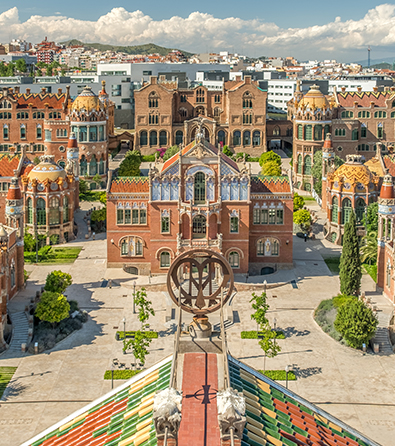
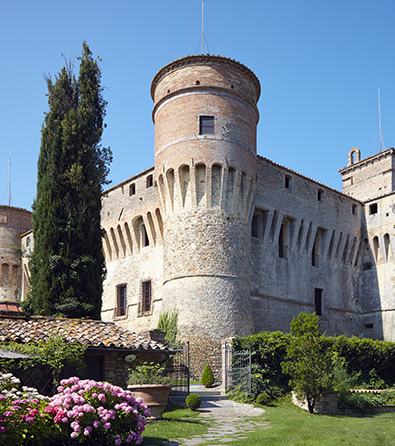
Sant Pau Recinte Modernista is a former hospital in Barcelona, now open to visitors. The Sant Pau Art Nouveau Site is one of the largest Art Nouveau complexes in Europe. It sits in the Guinardó area, a short walk uphill from the Sagrada Família. It was built between 1902 and 1930 as the Hospital de la Santa Creu i Sant Pau, designed by Lluís Domènech i Montaner, a leading figure of Catalan Modernisme.
For more recommendations, explore our full art, design and architecture guide to Barcelona and our curated selection of boutique and design hotels in Barcelona.
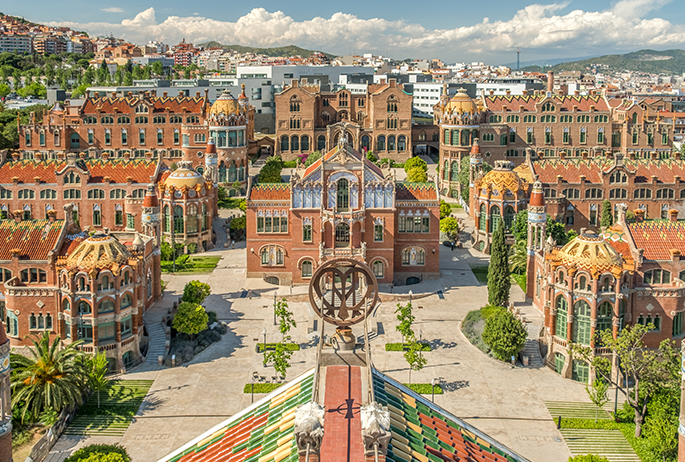 Photo: Robert Ramos. Courtesy of Recinte Modernista de Sant Pau
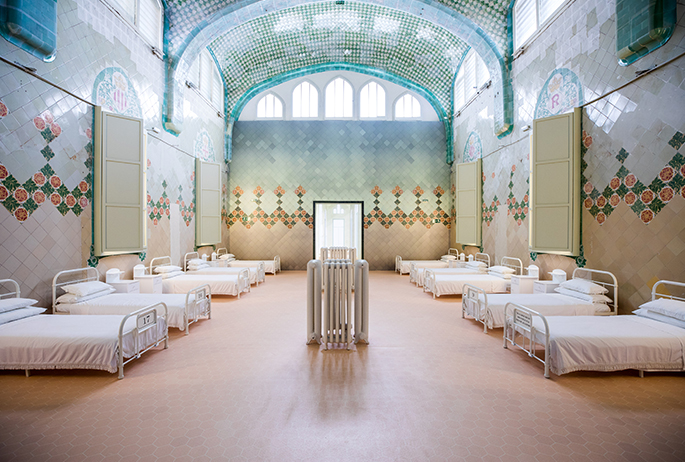 Photo: Robert Ramos. Courtesy of Recinte Modernista de Sant Pau
 Photo: Robert Ramos. Courtesy of Recinte Modernista de Sant Pau
- Photo: Robert Ramos. Courtesy of Recinte Modernista de Sant Pau
- Photo: Robert Ramos. Courtesy of Recinte Modernista de Sant Pau
- Photo: Robert Ramos. Courtesy of Recinte Modernista de Sant Pau
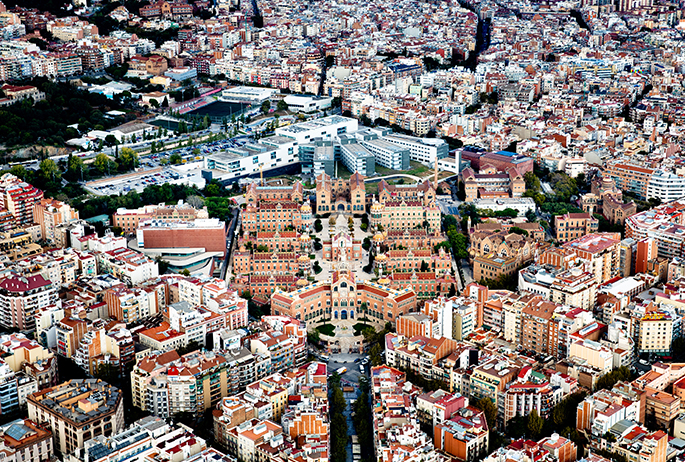 Photo: Robert Ramos. Courtesy of Recinte Modernista de Sant Pau
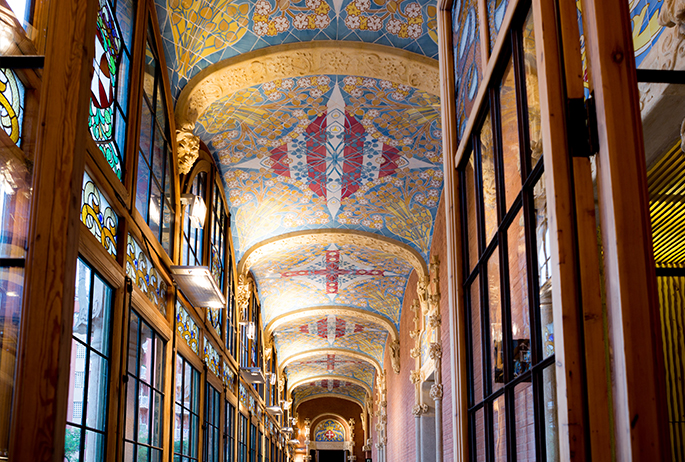
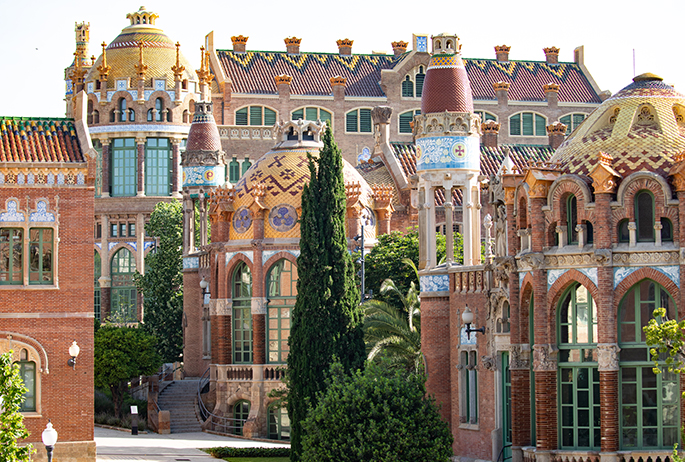
Modernisme was the local branch of Art Nouveau that reshaped Barcelona around 1900, through colour, curved lines, ceramics and craftsmanship. Most visitors meet the movement through private houses and concert halls. Sant Pau shows it working toward a different end: the care of the sick. The result is a complex of pavilions, gardens and underground tunnels, built around light, air and calm. The hospital moved to modern premises in 2009, and the restored site now opens to visitors on a self-guided or guided route.
In 1896, Pau Gil i Serra, a Catalan banker living in Paris, died and left his fortune to build a new hospital in Barcelona. He asked that it be dedicated to Saint Paul and bring together the best of contemporary technology, architecture and medicine. The city already had a hospital, the Hospital de la Santa Creu, which had served it for five centuries from a Gothic building in the Raval. Founded in 1401, that medieval institution could no longer keep pace with a growing city or with modern medicine.
The commission was entrusted to Lluís Domènech i Montaner (1850–1923), one of the central figures of Catalan Modernisme. Domènech was an architect, but also a teacher and historian. His work includes Barcelona landmarks such as the Palau de la Música Catalana, the Fonda Espanya, Casa Lleó Morera and Casa Fuster. As a lecturer at the Barcelona School of Architecture for more than four decades, he taught a generation that included Josep Puig i Cadafalch and Josep Maria Jujol. His studio worked closely with a fixed circle of technicians, artisans and manufacturers, designing the building and its decoration, the mosaics, ceramics and sculpture, as a single unified work, the goal Modernisme called the “total artwork.”
Work began in 1902 on the first ten buildings. Domènech researched the most advanced hospitals in Europe and new theories of sanitation, and decided to reject the single institutional block. In its place he designed a series of separate pavilions, each dedicated to a single medical specialty, set among gardens and connected below ground by a network of tunnels that moved services and patients out of sight. The whole complex was set at an angle to the surrounding streets of the Eixample. Its pavilions were arranged around two diagonal avenues that cross at the centre, tracing the shape of a cross pattée, the flared cross that served as the emblem of the old Hospital de la Santa Creu. In its plan, the new hospital carried the memory of the old one.
The original scheme called for 48 buildings; 27 were built, and 16 of those followed Domènech’s Modernista design. What sets the result apart is that patient wellbeing was treated as part of the medicine rather than a decorative afterthought. Natural light, ventilation, open space and a restrained elegance of decoration were the substance of the design, in a hospital built on the conviction that sunlight and gardens aided recovery. Domènech died in 1923, and his son, Pere Domènech i Roura, saw the work to completion. King Alfonso XIII inaugurated the hospital on 16 January 1930.
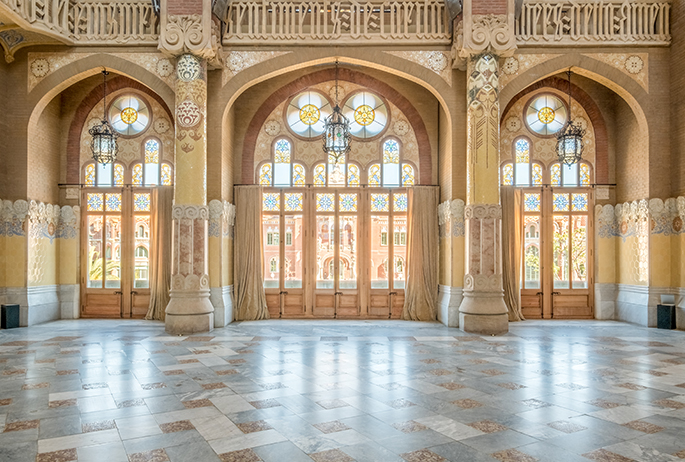
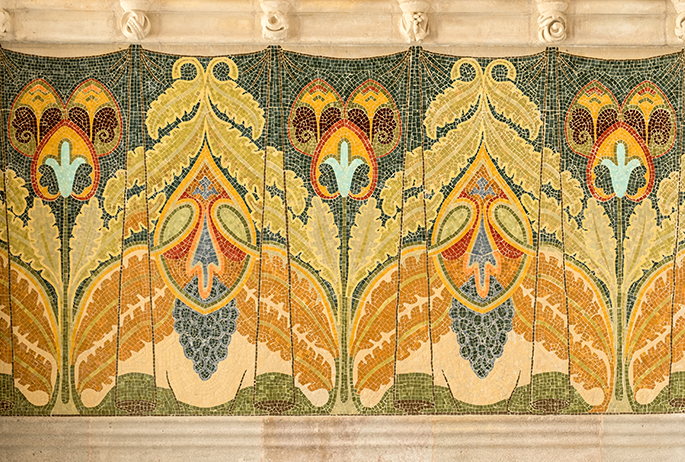
A visit to Sant Pau centres on the pavilions, separate buildings set among gardens, each originally built for a different medical specialty. The centrepiece of the complex is the Administration Pavilion. Across its façade runs the historical mosaic frieze that Domènech designed and built between 1906 and 1911, a history of Barcelona’s hospitals told panel by panel in ceramic and glass tesserae, from the ninth century to his own. Above it rises the clock tower that became a fixture of Barcelona’s postcards. Inside, the pavilion holds the most elaborate interiors on the site and today serves as an events venue for more than 600 people.
In 1978 the complex was declared a Historic Artistic Monument, and in 1997 UNESCO named it a World Heritage Site, jointly with Domènech’s Palau de la Música Catalana. By then, rising demand and the wear of the old buildings had made it hard for the Modernista pavilions to keep pace with modern medicine. In the autumn of 2009, the hospital’s medical work moved to a new complex, built for the hospital’s contemporary needs, at the northern end of the same grounds, and the Modernista pavilions were carefully restored to Domènech’s design. The institution itself continues there, treating patients and carrying out research a short walk north of its historic home.
Today, organisations working in innovation, sustainability, health, education and culture are based in the restored pavilions, where they run their own programmes and collaborate on shared projects. The site belongs to the Hospital de la Santa Creu i Sant Pau Private Foundation, made up of the Barcelona Cathedral Chapter, Barcelona City Council and the Generalitat de Catalunya, and is still governed by the body that has directed the institution since 1401, the Molt Il·lustre Administració. The Foundation also runs a cultural programme devoted to Domènech i Montaner, the heritage of the complex, and the institution’s long history in medicine.
The Administration Pavilion is also home to the Historical Archive of the Hospital de la Santa Creu i Sant Pau, one of the most important hospital archives in the world. It spans the fifteenth to the twenty-first century and is a primary source for the history of Barcelona and Catalonia.
For cultural travellers, Sant Pau rewards the short detour from the Sagrada Família. It carries several histories at once: a landmark of Catalan Modernisme, a chapter in the history of European hospital design, and a medical institution, founded in 1401, that is still at work. Few places show so plainly that a hospital could be built to lift the spirit as well as treat the body.