Milan brings together historic collections, contemporary art, major design institutions, and some of Italy’s most recognizable architectural landmarks, making it one of Europe’s most compelling cities for cultural travel. From Pinacoteca di Brera and Museo del Novecento to Fondazione Prada, Pirelli HangarBicocca, Triennale Milano, the ADI Design Museum, and landmarks such as Bosco Verticale and Bocconi’s New Urban Campus, the city offers a rich mix of art, design, architecture, and shopping. This guide also helps you plan where to stay in Milan while exploring key cultural areas such as Brera, the historic center, Porta Nuova, Navigli, and Tortona.
To access our exclusive Milan Treasure Map, simply click here and register as a member of our magazine. The map features every spot mentioned in this guide, along with additional recommendations for cafés, design stores, and cultural venues across the city.
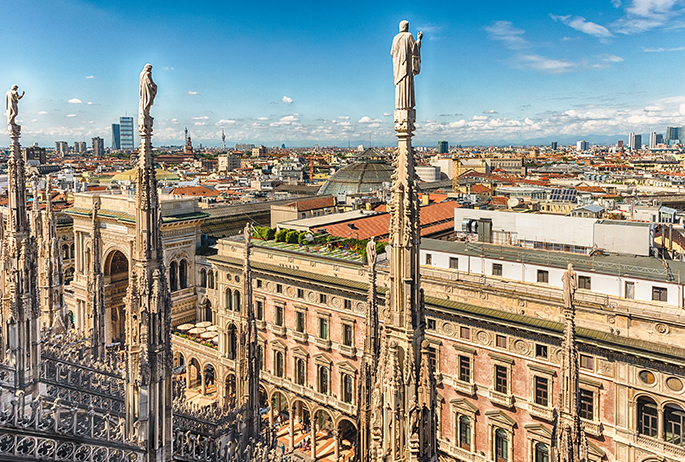
 View from the Duomo terraces. Photo: Envato Elements
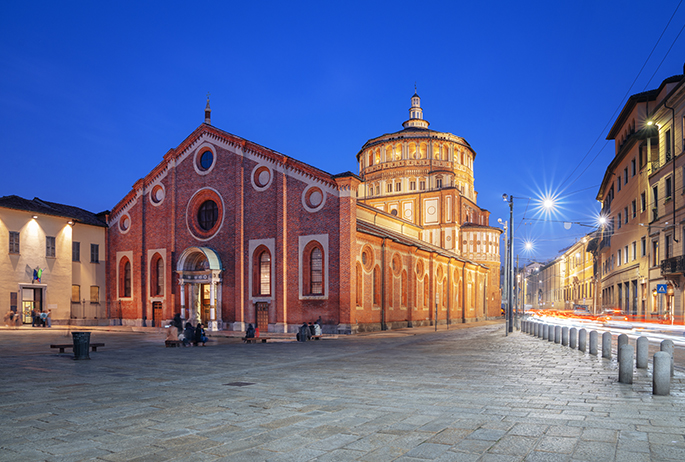
- Santa Maria delle Grazie. Photo: Envato Elements
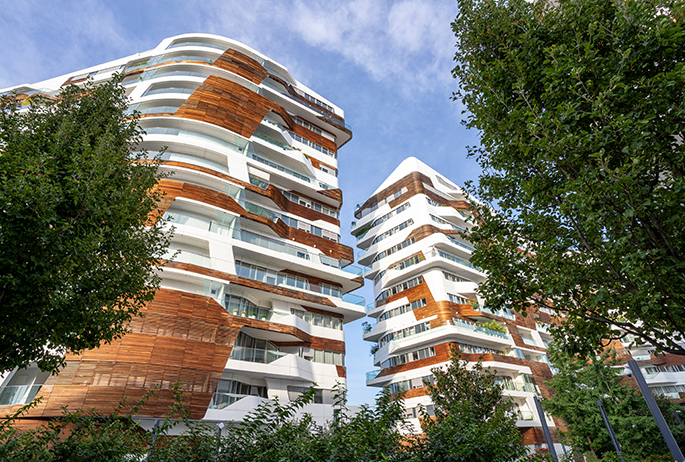
- CityLife Residences by Zaha Hadid Architects. Photo: Envato Elements
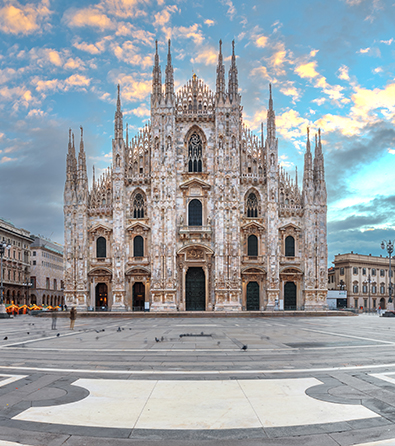
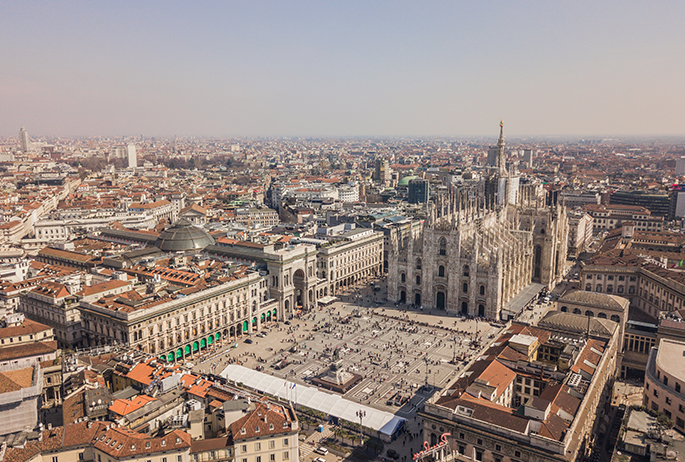
- Duomo di Milano and Piazza del Duomo. Photo: Envato Elements
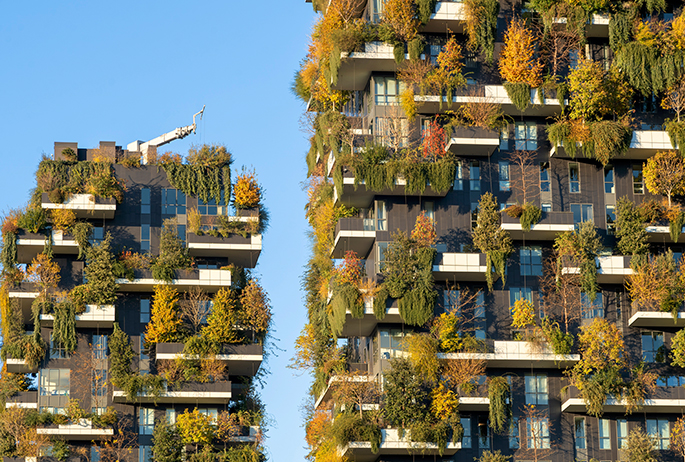
- Bosco Verticale in Porta Nuova, designed by Stefano Boeri Architetti. Photo: Envato Elements
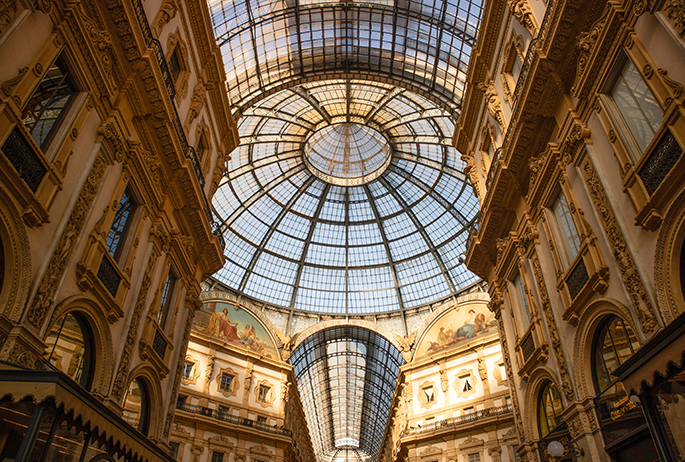
- Galleria Vittorio Emanuele II. Photo: Envato Elements
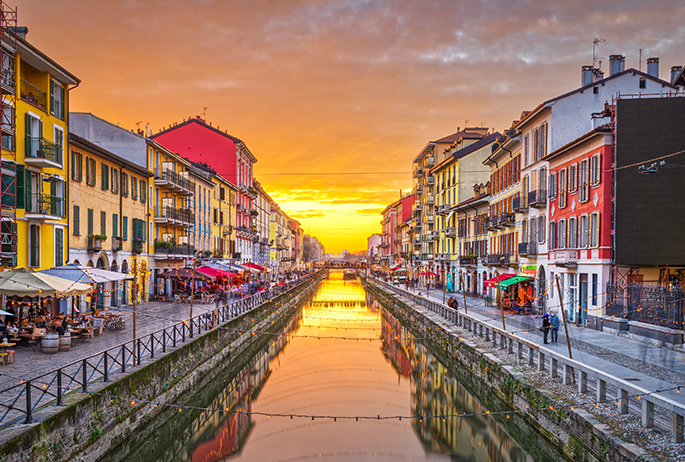
- Naviglio Grande. Photo: Envato Elements
Where to Stay in Milan
Planning your trip to Milan? Here are some of our recommended places to stay, from luxury hotels in the historic center and fashion district to more affordable options in lively, well-connected neighborhoods.
For a luxury stay in central Milan, Bvlgari Hotel Milano is tucked away on a private street between Brera, Via Montenapoleone, and La Scala, offering a discreet high-end base with a garden setting in the heart of the city. Mandarin Oriental, Milan is set just steps from the Duomo and La Scala, making it especially convenient for travelers who want a polished five-star stay near major landmarks. Portrait Milano, housed within the former Archiepiscopal Seminary on Corso Venezia, offers a refined luxury experience with immediate access to the Quadrilatero della Moda. Armani Hotel Milano, in the fashion district, suits travelers drawn to minimalist interiors and a strong design identity. Park Hyatt Milan is one of the best-placed options for visitors who want to stay just beside the Duomo and Galleria Vittorio Emanuele II. Palazzo Cordusio Gran Meliá, in a restored 19th-century landmark near Piazza Cordusio, works well for those who want a grand hotel close to the Duomo and the historic center. Grand Hotel et de Milan remains one of Milan’s classic addresses, just off Via Manzoni and close to La Scala and Via Monte Napoleone. Château Monfort – Relais & Châteaux, set in an early 20th-century Art Nouveau building, provides a more romantic and decorative alternative near San Babila and the Duomo.
For a mid-range stay across some of Milan’s most appealing neighborhoods, ME Milan Il Duca overlooks Piazza della Repubblica and suits travelers who want a contemporary hotel with easy access to Porta Nuova and the fashion district. Aethos Milan, in Navigli, is a boutique option for those who prefer a livelier, more local atmosphere near the canals. Radisson Collection Hotel, Santa Sofia Milan offers a more contemporary high-end feel in a central location south of the Duomo, near the university district and historic core. Hotel VIU Milan, in the Porta Volta area, is a design-led choice with skyline views and good access to both Chinatown and Brera. 3 Rooms 10 Corso Como Milano is ideal for travelers who want a highly specific fashion-and-design address within the 10 Corso Como complex near Porta Garibaldi. Vico Milano, on Corso Genova, provides a smaller boutique stay between the historic center, Navigli, and Tortona. Crossing Manzoni is a compact boutique accommodation within walking distance of Via Montenapoleone, La Scala, and the Duomo. Room Mate Giulia, just steps from the Duomo and Galleria Vittorio Emanuele II, is a particularly practical choice for first-time visitors who want central access without moving into Milan’s top luxury bracket.
For more affordable stays in well-connected areas, Urban Hive Milano, in Brera, offers a smart central base for travelers who want to stay near galleries, design shops, and the city center at a more moderate price point. Duo Milan Porta Nuova, a Tribute Portfolio Hotel works well for visitors who want to be close to Milano Centrale and the newer Porta Nuova district. 21 House of Stories Navigli combines hotel rooms with coworking, dining, and social spaces in one of Milan’s liveliest neighborhoods. For travelers looking for lower-cost options, Ostello Bello Grande is a practical hostel near Milano Centrale, especially useful for short stays and train connections, while YellowSquare Milan is a more social budget-friendly base with a youthful atmosphere and easy public transport access.
With the interactive map below, you can compare all available accommodation options in the city and find the best prices from a variety of leading providers.
Design Venues
Triennale Milano (Parco Sempione)
Why go: It is Milan’s main public institution for design, with a program that also includes architecture, visual culture, performance, and research.
Tip: Visit it as a broad cultural institution and include the Museo del Design Italiano during the same visit.
Founded in 1923 as the International Exhibition of Decorative Arts in Monza and relocated to Milan in 1933, Triennale Milano was created to present design, architecture, decorative arts, and modern industrial production within a shared cultural framework. It is housed in the Palazzo dell’Arte, the Rationalist building designed by Giovanni Muzio as its permanent home. Today, visitors come for temporary exhibitions on design and architecture, as well as for archives, talks, performances, and the Museo del Design Italiano, which presents key works from the history of Italian design within the broader context of the institution itself.
ADI Design Museum Compasso d’Oro (Monumentale)
Why go: It focuses on Italian industrial design through the history of the Compasso d’Oro, one of the country’s most important design awards.
Tip: Visit to gain a broader view of modern Italian design across furniture, domestic objects, graphics, transport, and communication.
Founded in 1956, ADI became the institutional home of the Compasso d’Oro, the design prize established in 1954 by La Rinascente and conceived by Gio Ponti and Alberto Rosselli to recognize excellence in Italian industrial design. The ADI Design Museum opened in 2021 in a converted 1930s industrial building in the Monumentale district, renovated by architects Giancarlo Perotta and Massimo C. Bodini. At its core is the Compasso d’Oro Historical Collection, which traces the development of Italian design from the postwar years onward through furniture, domestic objects, graphics, transport, and communication. Alongside the permanent collection, temporary exhibitions and events place that legacy in a contemporary context.
Armani/Silos (Tortona)
Why go: It places fashion within Milan’s wider design culture through the work of Giorgio Armani and the visual language he developed across clothing, materials, and display.
Tip: Pay attention to how the displays trace Armani’s use of color, fabric, and silhouette across different periods.
Opened in 2015 to mark forty years of Giorgio Armani’s career, Armani/Silos occupies a renovated granary built in 1950 on the site of the former Nestlé complex in the Tortona district. The renovation was conceived and overseen by Armani himself, who preserved the building’s austere industrial character and adapted it into a four-level exhibition space. The museum presents his work not only as fashion but as a coherent visual language shaped by proportion, restraint, materials, and display.
BASE Milano (Tortona)
Why go: It offers a view of Milan’s current creative scene through exhibitions, design projects, residencies, performances, and public programs.
Tip: Check the program before visiting, since what you see there depends on the current exhibitions, talks, workshops, or festivals.
Opened in 2016 in the former Ansaldo industrial complex in Tortona, BASE Milano was created as a center for contemporary culture, design, and experimentation within one of the city’s major urban regeneration projects. Rather than operating as a conventional museum, it functions as a hybrid institution where exhibitions, live events, residencies, and collaborative projects take place under one roof.
Rossana Orlandi (Magenta)
Why go: It is one of Milan’s most established venues for collectible contemporary design, known for presenting limited editions, experimental works, and emerging designers in a highly curated setting.
Tip: Visit with time to explore, since the gallery unfolds through multiple rooms and courtyard spaces rather than a single display hall.
Opened in Milan in 2002 by Rossana Orlandi in a former tie factory on Via Matteo Bandello, the gallery became one of the city’s defining venues for collectible design by giving early visibility to designers who later gained international recognition. Rather than following the structure of a museum, it unfolds through a sequence of rooms and courtyard spaces where furniture, lighting, objects, and artworks are presented in carefully staged environments.
Art Venues
Pinacoteca di Brera (Brera)
Why go: It is Milan’s most important museum for Italian painting, with a collection that spans from the late Middle Ages to the twentieth century.
Tip: Do not rush the visit, as the museum is best experienced as a sequence of major works across different periods.
Officially established in 1809, Pinacoteca di Brera grew out of the Accademia di Belle Arti di Brera, where works had already been assembled from 1776 onward for art instruction. It is housed within Palazzo Brera, a historic complex that also includes other major cultural institutions, among them the Braidense Library and the Botanical Garden. The museum remains Milan’s central institution for historical painting, with masterpieces by artists such as Mantegna, Bellini, Raphael, Piero della Francesca, Caravaggio, and Hayez.
Santa Maria delle Grazie / Cenacolo Vinciano (Santa Maria delle Grazie)
Why go: It is the site of Leonardo da Vinci’s “The Last Supper,” one of the most important works of the Renaissance.
Tip: Book well in advance, since entry is timed and visits are brief in order to protect the painting.
Santa Maria delle Grazie, the Dominican church and convent begun in 1463, is closely associated with Leonardo da Vinci’s “The Last Supper,” painted in the late 1490s. Originally designed by Guiniforte Solari, the complex is architecturally significant in its own right, but most visits are centered on Leonardo da Vinci’s mural. Entry is by reservation and limited to short viewing slots for conservation reasons.
Museo del Novecento (Duomo)
Why go: It is Milan’s main museum for twentieth-century Italian art.
Tip: Follow the collection in sequence, since the museum is organized as a chronological path through the twentieth century.
Opened in 2010 in the Palazzo dell’Arengario on Piazza del Duomo, Museo del Novecento was created to present works from Milan’s civic collections in a dedicated museum of twentieth- and twenty-first-century Italian art. The museum displays more than 300 works selected from a collection of over 4,000, with particular strength in the art of the first half of the twentieth century, especially Futurism and later modern movements. The building itself is part of the visit: the Palazzo dell’Arengario was converted into the museum by architect and designer Italo Rota together with architect Fabio Fornasari, and the galleries were designed as a chronological route through the century.
Fondazione Prada (Largo Isarco)
Why go: It is one of Milan’s main venues for contemporary art, with a program presented in a former industrial complex redesigned by OMA.
Tip: The architecture and layout of the site are part of the experience.
Founded in 1993 by Miuccia Prada and Patrizio Bertelli, Fondazione Prada opened its Milan venue in 2015 at Largo Isarco in a former distillery dating back to the 1910s. The site was designed by OMA, the Rotterdam-based architecture firm founded by Rem Koolhaas. Its layout combines seven existing buildings with three new structures, including the Podium, Cinema, and Torre. Its program includes contemporary art exhibitions as well as film, performance, conferences, and educational activities. Within Milan’s art scene, it stands out for the scale of its exhibitions and for the way the architecture remains an integral part of the visit.
Pirelli HangarBicocca (Bicocca)
Why go: It is one of Milan’s main venues for large-scale contemporary art and installation.
Tip: Reserve online in advance, since admission is free, but reservations receive priority access.
Established in 2004, Pirelli HangarBicocca is a non-profit foundation created and supported by Pirelli, the Italian company best known for tire manufacturing. It was developed in a former industrial complex in the Bicocca district as part of the wider transformation of this part of the city from a manufacturing area into a cultural and research hub. The institution focuses on large-scale installations and solo exhibitions shaped by the scale and character of the building. It is also home to Anselm Kiefer’s permanent installation “The Seven Heavenly Palaces,” which opened with the space and remains one of its defining works.
Padiglione d’Arte Contemporanea, PAC (Porta Venezia)
Why go: It is Milan’s main public institution dedicated specifically to contemporary art.
Tip: Check the exhibition calendar before visiting.
PAC was created as a municipal venue for contemporary art and opened in 1954 in a building designed by architect Ignazio Gardella. Located on Via Palestro beside Villa Reale and the Giardini Pubblici, it was conceived as a flexible exhibition space rather than a museum with a permanent collection. That format still defines the institution today. PAC presents temporary exhibitions by Italian and international artists, often through solo and thematic shows, and its long history has made it one of the city’s main public platforms for contemporary art.
Galleria d’Arte Moderna Milano, GAM (Porta Venezia)
Why go: It offers a strong introduction to nineteenth-century art in Milan within one of the city’s most elegant neoclassical residences.
Tip: Pay attention to both the collection and the setting, since the villa is part of the visit.
GAM is housed in Villa Reale, also known as Villa Belgiojoso, a neoclassical residence built between 1790 and 1796 for Count Lodovico Barbiano di Belgiojoso and designed by architect Leopoldo Pollack. The museum has displayed Milan’s modern art collections there since 1921, and today presents a broad selection of works from the late eighteenth century to the early twentieth century, including sculpture and painting by artists such as Canova, Hayez, Segantini, and Medardo Rosso.
Villa Necchi Campiglio (Porta Venezia)
Why go: It is one of Milan’s finest house museums, combining early twentieth-century architecture, interiors, and art collections.
Tip: Go for the interiors as much as for the art, since the house itself is the main reason to visit.
Built between 1932 and 1935 for the Necchi Campiglio family, Villa Necchi Campiglio was designed by architect Piero Portaluppi in one of Milan’s most elegant residential districts. The villa preserves the atmosphere of an upper-class Milanese home of the interwar period, with interiors, decorative details, and later additions that reflect changing taste over time. Today, under the care of FAI, it functions as a house museum that also includes significant art collections, among them the Alighiero and Emilietta de’ Micheli Collection, the Claudia Gian Ferrari Collection, and the Guido Sforni Collection. Together, they add eighteenth-century painting, twentieth-century art, and drawings by major modern artists to the visit.
MUDEC (Tortona)
Why go: It presents Milan’s ethnographic collections alongside temporary exhibitions that connect world cultures with contemporary visual art and current themes.
Tip: Check the temporary exhibitions before visiting, since they are a central part of the museum’s program.
MUDEC, the Museum of Cultures, opened in 2015 in the former Ansaldo industrial area on Via Tortona, in a building designed by David Chipperfield. It was created to house the City of Milan’s ethnographic collections, which include more than 7,000 objects from Africa, Asia, the Americas, and Oceania, while also functioning as a space for temporary exhibitions. Since 2022, the museum has placed greater emphasis on cross-disciplinary exhibitions and contemporary commissions, including site-specific installations in its central Agora. What distinguishes MUDEC within Milan’s museum landscape is this combination of historical collections, contemporary exhibition-making, and a broader focus on global cultures rather than on Italian art alone.
Fondazione Elpis (Porta Romana / Crocetta)
Why go: It focuses on emerging contemporary artists through exhibitions, residencies, and site-specific projects.
Tip: Check what is currently on view before visiting, since the program changes and the space is exhibition-led rather than collection-based.
Founded in 2020 by collector and patron Marina Nissim, Fondazione Elpis was established to support emerging artists and new forms of artistic production through exhibitions, commissions, and residencies. It is located in a former retirement home on Via Lamarmora, adapted as a space for artistic research and experimentation. Rather than building a permanent collection, the foundation works through changing projects and public programs. It is also the organization behind “Una Boccata d’Arte,” the annual initiative that places artists in villages across Italy. In Milan, the space functions as a smaller contemporary venue with a clear focus on emerging art and site-specific work.
Art Galleries
Among Milan’s leading galleries, Lia Rumma is one of the city’s most established names for contemporary art, with a history closely associated with Arte Povera, conceptual art, and major international artists; the gallery was founded in Naples in 1971 and later expanded to Milan. Cardi Gallery focuses on modern and contemporary art, with particular strength in postwar Italian art alongside international artists. Gió Marconi is an important Milan gallery for contemporary art, and its history is closely tied to Studio Marconi, founded by Giorgio Marconi in 1965, before Gió Marconi opened his own gallery in 1990. Kaufmann Repetto adds a younger and more contemporary perspective, with spaces in both Milan and New York and a program centered on current artistic practices. Massimo De Carlo is one of the city’s most prominent contemporary galleries, with an international roster and a longstanding presence in Milan’s art market. Raffaella Cortese is known for a rigorous contemporary program and for representing major international artists, especially in work that engages with installation, photography, and conceptual practices. Christian Stein remains an important historical name in Milan’s gallery scene, particularly for its long association with postwar and contemporary Italian art.
Architectural Highlights
Feltrinelli Porta Volta / Herzog & de Meuron (Porta Volta)
Why go: It is one of Milan’s most prominent recent public buildings and a key example of how contemporary architecture has been used to reshape the Porta Volta area.
Tip: Walk around the building rather than viewing it only from the front, since its long, narrow form was designed in relation to the surrounding streets and open space.
Completed in 2016, the Fondazione Giangiacomo Feltrinelli building was designed by Herzog & de Meuron, the Swiss architecture firm founded by Jacques Herzog and Pierre de Meuron. It was built as the new headquarters of the foundation and as part of a wider redevelopment of Porta Volta, a historic gateway area along the former Spanish walls. The design takes its cues from Lombard vernacular and historic Milanese architecture, translating them into a long glazed structure with a steep, repetitive roof profile.
Bosco Verticale / Stefano Boeri Architetti (Porta Nuova / Isola)
Why go: It is one of Milan’s most recognizable recent residential projects and a key example of how architecture in the city has addressed density, greenery, and urban regeneration together.
Tip: View it from the street and surrounding public spaces rather than as a destination to enter, since the project is best understood through its relationship to the skyline and the neighborhood around it.
Completed in 2014 in the Porta Nuova district at the edge of Isola, Bosco Verticale consists of two residential towers designed by Stefano Boeri Architetti. The project was developed as part of the wider redevelopment of Porta Nuova and is best known for integrating trees, shrubs, and plants directly into the façades of the towers. According to the architects, the two buildings host 800 trees, 4,500 shrubs, and 20,000 plants from around one hundred species. Its significance lies not only in its image, but in the way it proposed a new model for high-density housing in which vegetation becomes part of the architecture rather than a separate landscape element.
Bocconi New Urban Campus / SANAA (Bocconi)
Why go: It is one of Milan’s most important recent campus projects and a strong example of how contemporary architecture has been integrated into the city rather than separated from it.
Tip: Walk through the public areas as well as around the buildings, since the project was designed as an open urban campus rather than a closed academic complex.
Inaugurated in 2019 on the former Centrale del Latte site, the Bocconi New Urban Campus was designed by SANAA, the Japanese architecture firm led by Kazuyo Sejima and Ryue Nishizawa. The project expanded the university south of Via Sarfatti and includes the new SDA Bocconi buildings, a residence hall, a sports center, and a public park. What makes it significant is not only the architecture of the individual buildings but the way the campus was conceived as part of the surrounding city, with transparent facades, open circulation, and green space accessible to the public.
CityLife Residences / Zaha Hadid Architects (CityLife / Tre Torri)
Why go: They are one of Milan’s best-known recent residential projects and an important part of the CityLife redevelopment of the former trade fair grounds.
Tip: View them from the surrounding public paths and park, since the project is best understood in relation to the wider CityLife masterplan rather than as a building to enter.
Designed by Zaha Hadid Architects and built between 2004 and 2014, the CityLife Residences form part of the large-scale redevelopment of the former Fiera Milano site after the fair moved to Rho in 2005. The project includes seven residential buildings arranged around landscaped areas and a public park, and was planned as part of a new mixed-use district of housing, offices, retail, and civic space. Their significance lies in the way the curving forms of the buildings contribute to the identity of CityLife as a whole, where residential architecture was used together with open space and new infrastructure to redefine a major part of the city.
Fondazione Luigi Rovati / Mario Cucinella Architects (Porta Venezia)
Why go: It combines a museum of Etruscan art with a recent architectural intervention inside a nineteenth-century palazzo.
Tip: Pay attention to both levels of the museum, since the project was designed around the contrast between the historic building above ground and the contemporary galleries below.
Fondazione Luigi Rovati is housed in Palazzo Bocconi Rizzoli Carraro, a late nineteenth-century residence on Corso Venezia. Opened in 2022, the museum was created through the restoration, renovation, and expansion of the existing palazzo by Mario Cucinella Architects. The historic rooms above ground were adapted for exhibitions and public use, while new underground galleries were added for the foundation’s collection of Etruscan art. The project is defined by the contrast between the original building and the contemporary spaces inserted below it.
Design & Art Events
Salone del Mobile (Rho Fiera, April)
Why go: It is the main international fair for furniture and design in Milan and the core professional event of Milan Design Week.
Tip: Buy tickets in advance and choose your visit day early, since admission is date-based and the fair is large enough to require planning.
Founded in 1961, Salone del Mobile remains the central trade fair of Milan’s design calendar. Its importance lies in the concentration of Italian and international brands, product launches, and sector-specific sections within one site. For visitors interested in design as industry, production, and material culture, this is the main event of the week.
Fuorisalone (citywide, April)
Why go: It extends Milan Design Week across the city through installations, exhibitions, launches, and temporary projects outside the fairgrounds.
Tip: Focus on one or two districts rather than trying to cover the whole city in a single day.
Fuorisalone is the network of events that takes place across Milan during the same week as Salone del Mobile. It is not a single fair and does not have one central organizer or one ticketed venue. Instead, it unfolds through districts such as Brera, Tortona, 5Vie, and Porta Venezia, where showrooms, historic buildings, galleries, and public spaces become part of the program. For many visitors, this is the part of Design Week that reveals how design enters the fabric of the city itself.
Alcova (citywide, during Milan Design Week)
Why go: It is one of the main platforms for experimental and collectible design during Milan Design Week.
Tip: Check the locations in advance, since Alcova changes sites and is organized around specific buildings rather than a single permanent venue.
Founded in 2018 by Valentina Ciuffi and Joseph Grima, Alcova has become a recurring part of Milan Design Week by placing design exhibitions in architecturally and historically unusual sites. Its program typically brings together emerging designers, established studios, and experimental projects in settings chosen as carefully as the works themselves. Its value lies in the way it combines contemporary design with temporary access to spaces that are not usually part of the city’s regular cultural circuit.
miart (Allianz MiCo, April)
Why go: It is Milan’s main fair for modern and contemporary art.
Tip: Check the exhibitor list before visiting, since the fair brings together galleries across different periods and market segments.
miart is the city’s international art fair for modern and contemporary art and is held at Allianz MiCo. Its structure is important because it places twentieth-century art, postwar work, and contemporary practice within the same fair context.
Milan Art Week (citywide, spring)
Why go: It brings together exhibitions, openings, and public programs across the city’s museums, foundations, and galleries.
Tip: Check the citywide program before your trip, since the schedule changes each year and events are spread across multiple venues.
Milan Art Week functions as the city’s main annual platform for contemporary art beyond the fair format. Rather than being tied to one venue, it unfolds through institutions, galleries, and special projects across Milan, often in dialogue with miart and the broader spring art calendar.
Design Shopping
Nilufar (Brera)
Why go: It is one of Milan’s key addresses for historical and contemporary design.
Tip: Visit if you want to see vintage design and contemporary pieces presented within the same curatorial framework.
Founded in Milan in 1979 by Nina Yashar, Nilufar is known for its focus on vintage design masterpieces alongside contemporary work by established and emerging designers. Its gallery on Via della Spiga places historical and new pieces in direct relation to one another, which gives the space a broader perspective than a conventional showroom. Both Nilufar locations are open to the public Monday through Saturday.
Nilufar Depot (Farini area)
Why go: It extends the Nilufar program into a larger space dedicated to exhibitions and collectible design.
Tip: Go if you want a fuller sense of Nilufar’s exhibition approach beyond the central gallery.
Nilufar Depot on Viale Lancetti is the larger of the two Nilufar spaces and functions as an exhibition venue as well as a design destination. It has been used for curated installations, fairs, and special projects, giving it a stronger temporary-exhibition dimension than the gallery in Brera. It is open to the public Monday through Saturday.
10 Corso Como (Porta Garibaldi)
Why go: It is one of Milan’s best-known concept stores, combining fashion, design, books, exhibitions, and food within a single address.
Tip: Allow time to move through the full complex rather than treating it as a shop only, since the experience includes retail, exhibition spaces, and hospitality.
Founded in 1991 by Carla Sozzani, 10 Corso Como helped define the concept-store model in Milan by bringing together fashion, design, publishing, and contemporary culture in one place. The site occupies an early twentieth-century industrial building and was redesigned in 2024 by 2050+, the Milan-based agency co-founded by Ippolito Pestellini Laparelli.
NonostanteMarras (Porta Venezia area)
Why go: It combines fashion, objects, books, and events in a concept-store format.
Tip: Go if you want a more hybrid stop rather than a design gallery in the strict sense.
NonostanteMarras is Antonio Marras’s Milan space on Via Cola di Rienzo. Unlike the other entries in this section, it is not focused only on collectible design, but on a broader mix of fashion, objects, and cultural programming.